Chinese New Year 2027 (Feb 6): A Foreigner's Guide to Crowds, Closures & Real Festivities
Most English guides tell you to avoid China during Chinese New Year. They are half right.
February 6, 2027 begins the Year of the Goat. In the 40 days around that date — officially, 15 days before and 25 days after — China runs the largest annual human migration on the planet. In 2026 that meant 9.41 billion inter-regional trips in 40 days, an average of roughly 235 million a day. Train tickets vanish. Hotel prices in the trendy spots triple. Some smaller businesses shut their doors.
But those guides miss what makes New Year worth the trouble. The big cities empty out because locals go home. Major attractions stay open. And the festival itself, the temple fairs and lantern displays and flower markets, only exists for these two weeks. Come during Chinese New Year and you see a China that does not exist the rest of the year. Come ignorant of how it works and you spend a week fighting crowds for closed restaurants. Five weeks earlier comes a much quieter crossover: December 31, which follows almost none of the Spring Festival rules. We cover that one separately in New Year’s Eve in China 2027.
What follows is the practical version: the 2027 dates, what is confirmed and what is not, what really closes, where the fun is, and how to dodge the worst of the crowds.
Quick answer: Chinese New Year 2027 falls on Saturday, February 6 (Year of the Goat). The official holiday has not been announced yet; on the rules published with the 2024 revision, and on the pattern of the last two years, expect roughly February 5–12 or 13, 8–9 days, with the State Council notice likely in October or November 2026. Three quirks most guides miss: there is no “lunar December 30th” in 2027, so New Year’s Eve is February 5, the 29th; about four in five Chunyun trips are made by private car (79.3% in 2026), not train; and the single best window is February 7–9, when the megacities feel half-empty. Big cities empty out while temple fairs and lantern shows fill in. For the other super-surge, see our National Day Golden Week guide; for the season-by-season view, the worst time to visit China; for the quiet autumn reunion festival, our Mid-Autumn 2026 guide.
How we verified this: SinoWander reads Chinese-language sources that English guides cannot, including State Council holiday notices, Ministry of Transport chunyun data, the official 12306 ticket system, Ctrip, and Palace Museum announcements. We cross-check them before writing. We have not personally visited every location. Each guide is date-stamped when last verified: 2026-09-24. See our methodology.
The 2027 Dates You Need
Chinese New Year’s Day: February 6, 2027 (Saturday), the start of the Year of the Goat (the English “Goat” is the most common translation; Chinese does not distinguish goat from sheep). Hong Kong and Macau have both already gazetted 6 February 2027 as Lunar New Year’s Day in their official holiday tables, which is as close to a fixed anchor as you will get this far out.
Lichun, the Start of Spring and the first of the 24 solar terms, falls on February 4, two days earlier. That makes 2027 slightly unusual: Lichun (Feb 4), New Year’s Eve (Feb 5) and New Year’s Day (Feb 6) land on three consecutive days.
New Year’s Eve: February 5 (Friday). Read this carefully. There is no “30th of the 12th lunar month” in 2027. The last lunar month runs only 29 days, so New Year’s Eve falls on the 29th. This is not a trick of the calendar — a lunar month is 29 or 30 days depending on the actual new moon, and 2027’s twelfth month is a short one.
According to the Purple Mountain Observatory (Chinese Academy of Sciences), the twelfth lunar month is a short month for five consecutive years, 2025 through 2029, so none of those years has a “big year-thirty.” The next Lunar New Year’s Eve falling on the 30th does not come until 2030. Most English resources get this wrong, and getting it wrong means showing up on the wrong day for the reunion dinner. Either way, chuxi — the eve itself — is always there.
Lantern Festival: February 20 (Saturday), the 15th day of the new year and the traditional end of the celebrations. It is not a public holiday in mainland China, so nothing official closes for it, but it is when lantern displays peak and then come down.
Longtaitou (Dragon Raises Its Head): March 9, 2027 (Tuesday), the second day of the second lunar month. It matters for one practical reason, covered below: it is the traditional end of the “no haircuts” month.
Leading up to it, two dates worth knowing if you are in China in January:
- Laba (腊八), 15 January 2027 — the eighth day of the twelfth lunar month, traditionally marked with laba congee. Temples in Beijing and Hangzhou hand out free servings.
- Xiaonian (小年), 31 January 2027 — the 24th day of the twelfth lunar month, “little year,” when the Spring Festival cleaning and shopping visibly begin.
| Date | Day | What it is |
|---|---|---|
| 15 Jan 2027 | Fri | Laba (腊八) — 8th day of 12th lunar month |
| 31 Jan 2027 | Sun | Xiaonian (小年) — 24th day, festival prep begins |
| 22 Jan 2027 (projected) | Fri | Chunyun starts (15 days before New Year’s Eve) |
| 4 Feb 2027 | Thu | Lichun (立春), Start of Spring |
| 5 Feb 2027 | Fri | New Year’s Eve (除夕) — 29th, not 30th |
| 6 Feb 2027 | Sat | New Year’s Day (正月初一) — Year of the Goat |
| 7–9 Feb 2027 | Sun–Tue | Quiet window: cities at their emptiest |
| 20 Feb 2027 | Sat | Lantern Festival (元宵节), 15th day |
| 2 Mar 2027 (projected) | Tue | Chunyun ends (25 days after New Year’s Day) |
| 9 Mar 2027 | Tue | Longtaitou (龙抬头) — traditional first haircut |
The Public Holiday: Not Yet Announced (And Why 9 Days Is Likely)
As of 24 September 2026, the State Council has not published the 2027 holiday calendar. This is the single biggest thing to check before you book flights.
What we can say with confidence:
- Under the rules published alongside the 2024 revision of the national holiday regulations, the Spring Festival statutory days are New Year’s Eve and Days 1 to 3 (four days), and the block normally runs 8 days with weekend make-up.
- The official policy briefing on that revision specifically notes that when New Year’s Eve falls on a Friday, the break can be extended to 9 days by linking to the weekend — and 2027 is the example the briefing itself cites. In 2027, New Year’s Eve is Friday 5 February, so a 9-day break is the likely outcome.
- On timing: the 2026 notice was issued on 4 November 2025 and the 2025 notice on 12 November 2024, but the 2024 notice came out on 25 October 2023. Expect the 2027 notice in October or November 2026, and check gov.cn before you commit to non-refundable tickets.
Treat February 5–12/13 as a projection, not a date. The end date is the least certain part: eight days from 5 February ends on 12 February (a Friday, landing exactly on Day 7 — the cleanest option), while a nine-day version could run 5–13 February or, following the 2026 precedent of starting two days before the eve, 4–12 February. We will update this page the moment the notice is released.
For comparison, the two most recent actual breaks: 2025 ran 28 January – 4 February (8 days); 2026 ran 15–23 February (9 days, starting on the 28th of the twelfth lunar month). Make-up workdays on the adjacent weekends are announced in the same notice — in 2026 those were Saturdays 14 and 28 February.
Chunyun: The 40-Day Migration
Chunyun is not the holiday week. It is a 40-day window built on a fixed formula the Ministry of Transport stated explicitly for 2026: 15 days before New Year’s Eve, 25 days after New Year’s Day. For 2026 that produced 2 February – 13 March; applying the same formula to 2027 gives a projected 22 January – 2 March 2027. The ministry’s 2027 plan is not expected until January 2027, so treat those dates as projected.
The scale. During the 40 days of Chunyun 2026, China recorded 9.41 billion inter-regional passenger trips — a record, and 4.3% more than 2025’s 9.02 billion, according to the Ministry of Transport. That works out to about 235 million a day. The single busiest day was 22 February 2026 (the sixth day of the new year) at 380 million trips in 24 hours, also a record.
How people actually move. This is where English guides go wrong. “Everyone takes the train home” is mostly false. Around four in five trips are made by private car:
| Mode | 2026 trips | Share |
|---|---|---|
| Private car (self-drive) | 7.46 billion | 79.3% |
| Road, commercial coach | 1.28 billion | 13.6% |
| Rail | 538 million | ~5.7% |
| Air | 94.4 million | ~1.0% |
| Water | 36.0 million | ~0.4% |
If the road-trip idea appeals, our China self-driving and rental guide explains the temporary driving permit foreigners need — though for a first-time visitor in February, driving in Heilongjiang or Inner Mongolia is a genuinely bad idea.
Here is the part that matters for you: none of that helps. As a foreigner without a Chinese driver’s licence and no family car to pile into, you compete for the rail and air seats that make up under 7% of the total — against everyone else who also cannot drive home. That is why tickets are still impossibly hard to get, even though the trains carry a minority of travellers.
Peak crush:
- Before the festival: February 3–5, everyone leaving the cities for hometowns
- After: February 10–12, everyone returning
The quiet window: February 7–9, the second to fourth days of the new year. Most people are home with family, not travelling. Beijing and Shanghai feel half-empty. This is the rare moment when the Forbidden City is close to walkable.
One visible shift worth knowing: “reverse Chunyun” (反向春运) — parents travelling to the city where their adult children work, instead of the children going home. Meituan Travel reported that January 2026 bookings for such reverse-trip flights were roughly 35% higher than a year earlier. Note what that is: platform data on one month of flight bookings, not an official statistic, and not a 40-day figure. It is one small reason the big cities are not quite as empty as they used to be.
How to Actually Get a Ticket
Train tickets go on sale 15 days before departure, counting the departure day, on 12306, the official railway booking platform. For New Year’s Day (6 February 2027) that means tickets drop around 22 January, and popular departures go in minutes.
Two things most guides get wrong or omit:
- Every ticket in China originates on 12306. Trip.com and Ctrip sell the same inventory at a markup. Our full walkthrough is in How to Buy China Train Tickets; if you are considering sleeping your way across the country instead of fighting for a seat, see China’s Overnight Sleeper Trains.
- A new reservation channel exists, but it does not extend the 15-day window. Since 20 July 2026, a pilot “reservation purchase” service on Beijing–Shanghai high-speed and conventional services lets you file a request 60 to 17 days before departure; the system fulfils it 20 to 16 days before departure. Each account may hold up to 3 pending orders, each for up to 19 passengers, and it does not cover groups larger than 19. Useful if you are on that corridor, useless elsewhere.
Practical tactics that work:
- Be on 12306 the minute tickets drop, with passenger details and payment already set up. Foreign passports work, but register and verify in advance — verification can take hours.
- Use the waitlist (候补). It is a real queue, not a lottery, and it is where cancelled tickets go first.
- Fly the peak days. Air is only about 1% of chunyun volume; on 3–5 February, airfare is often the least painful option even at holiday pricing.
- Travel on 6–9 February if you can. Trains on New Year’s Day itself are markedly emptier than on either side of it.
- Book the return leg first. The post-festival return (10–12 February) is more compressed and more predictable than the outbound rush.
What’s Open and What’s Closed
This is the part most guides get wrong, and it is where foreigners get caught out.
The myth: China shuts down for New Year.
The reality: Large chains, shopping malls, convenience stores, and tourist attractions stay open, busier than usual. What closes is the small stuff. Family-run restaurants, noodle stands, barbershops. The owners go home, usually from about a week before the festival through the 15th day, Lantern Festival on February 20.
Mall hours follow a consistent pattern across cities, confirmed across Beijing, Shanghai, Chengdu, Hangzhou, and Wuhan in 2026:
- New Year’s Eve (February 5): 10:00 to 16:00 or 18:00, closing early
- Day 1 (February 6): 11:00 to 20:00, opening late
- Day 2 onward: back to normal, 10:00 to 22:00
Convenience stores (7-Eleven, FamilyMart, Lawson) stay open 24 hours in major cities. International chains like McDonald’s and Starbucks operate normally. Supermarkets like Hema and Walmart open with shorter hours. Public transport keeps running, though metro lines near temple fairs get crushed — see How to Use China’s Subway & Bus.
What actually closes or slows:
- Small private restaurants and shops: often shut from a week before through Lantern Festival
- Banks: branch counters are generally closed Days 1 to 3 (roughly 7–9 February 2027), with some branches keeping limited or half-day hours, and most reopening from Day 4. New Year’s Eve itself is often a half day. ATMs, mobile banking and online banking run throughout. There is no single national rule — arrangements are published bank by bank each January, so check your own bank’s notice. Holiday-open branches usually handle personal business only. For the wider picture on money, see How to Pay in China.
- Delivery (SF Express, JD): both run through the holiday but add a peak-season “resource adjustment fee.” In 2026 SF Express applied it to shipments during the holiday week itself; JD Logistics added 0.1–1.2 yuan/kg on express freight from 19 January to 23 February. Both warn only that delivery times “may be affected to varying degrees” — there is no official 1–2 day figure, so allow extra days rather than trusting a number.
- Government service halls: counters at local government service centres typically close for the whole holiday — they closed for all nine days in 2026 — though a few cities reopen selected windows such as public security and tax on Days 6–7, and 24-hour self-service kiosks plus online portals stay available. Nothing that needs a stamp or a counter should be scheduled into this week.
The “half-silent” hours are New Year’s Eve afternoon into Day 1 morning. Many places shut after lunch for the reunion dinner, and the streets go quiet. By Day 4, commerce is mostly back.
One superstition English guides will not mention. Many Chinese avoid haircuts during the first lunar month; the old saying is that it brings bad luck to your mother’s brother. The phrase is widely thought to be a corruption of “si jiu” — mourning the old dynasty — rather than “si jiu,” killing your uncle. Shops are packed in the week before New Year’s Eve.
What has changed: barbershops do not close for a month. Plenty now reopen by Days 4–8, and reporting from 2026 describes first-month business as no longer slow, with younger customers ignoring the taboo. What is still true is the traditional “first cut” — Longtaitou on 9 March 2027, when barbers in Beijing reported several times their normal volume. So get your haircut before 5 February, not because you cannot find an open shop in February, but because you will be queueing.
The Forbidden City Trap (And Other Museums)
The Forbidden City catches people out. In 2026 the Palace Museum closed for the entire day on 16 February — the last day of the twelfth lunar month, which in 2026 was the 29th, not the 30th — and reopened on Day 1. It then ran normally from 17 to 23 February.
Two corrections to how this is usually reported in English:
- The closure day is the last day of the twelfth lunar month, whatever number that happens to be. In a year with no 30th, it falls on the 29th. The Palace Museum’s own English notice calls 16 February “Chinese New Year’s Eve,” which is fair enough — the point is the date, not the label.
- “The same logic applies to other major museums” is too broad. In 2026: the National Museum of China followed the same pattern (closed on the eve, open from Day 1) — but the Prince Gong Mansion closed on both New Year’s Eve and Day 1, and the Peking University Arthur M. Sackler Museum closed for the entire holiday. Check each museum individually.
For 2027, expect a full-day closure on 5 February and normal opening from 6 February — but confirm on dpm.org.cn when the museum publishes its holiday notice, usually in late January. One more detail for 2027 specifically: the Spring Festival falls inside the low season (1 November – 31 March), when the Palace Museum closes at 16:30 with last entry at 15:30, not the 17:00 seen in some holiday notices. Book and plan around that with our Forbidden City guide.
Where to Find the Real Festivities
If you come for New Year, come for these. They only exist for two weeks.
Beijing, Ditan Temple Fair. The classic. Running since 1985 — one of the first temple fairs revived in Beijing — it has in recent years opened on Lunar New Year’s Day and run for about seven days (Day 1 to Day 7), typically 08:30–17:00. A costumed reenactment of the Qing-dynasty imperial sacrifice to the Earth is staged at the Square Water Altar (方泽坛) once each morning, from 09:00 to 09:30 — not 10:00, as older English guides and outdated Chinese listings still say. Get there early if you want a front-row spot. The 2025 edition (the 37th) drew more than 600,000 visits over its seven-day run, according to People’s Daily Online.
Also worth a visit: Changdian (厂甸) in Xicheng district — a national-level intangible cultural heritage with more than 400 years of history — plus Longtan (which drew 300,000-plus visits in 2025) and the Baiyunguan (White Cloud Taoist Temple), where the traditional ritual is to touch the stone monkey carvings for good luck. The 2027 dates for all of these had not been announced as of September 2026; Beijing usually confirms them in January. Start with our Beijing travel guide for the surrounding logistics.
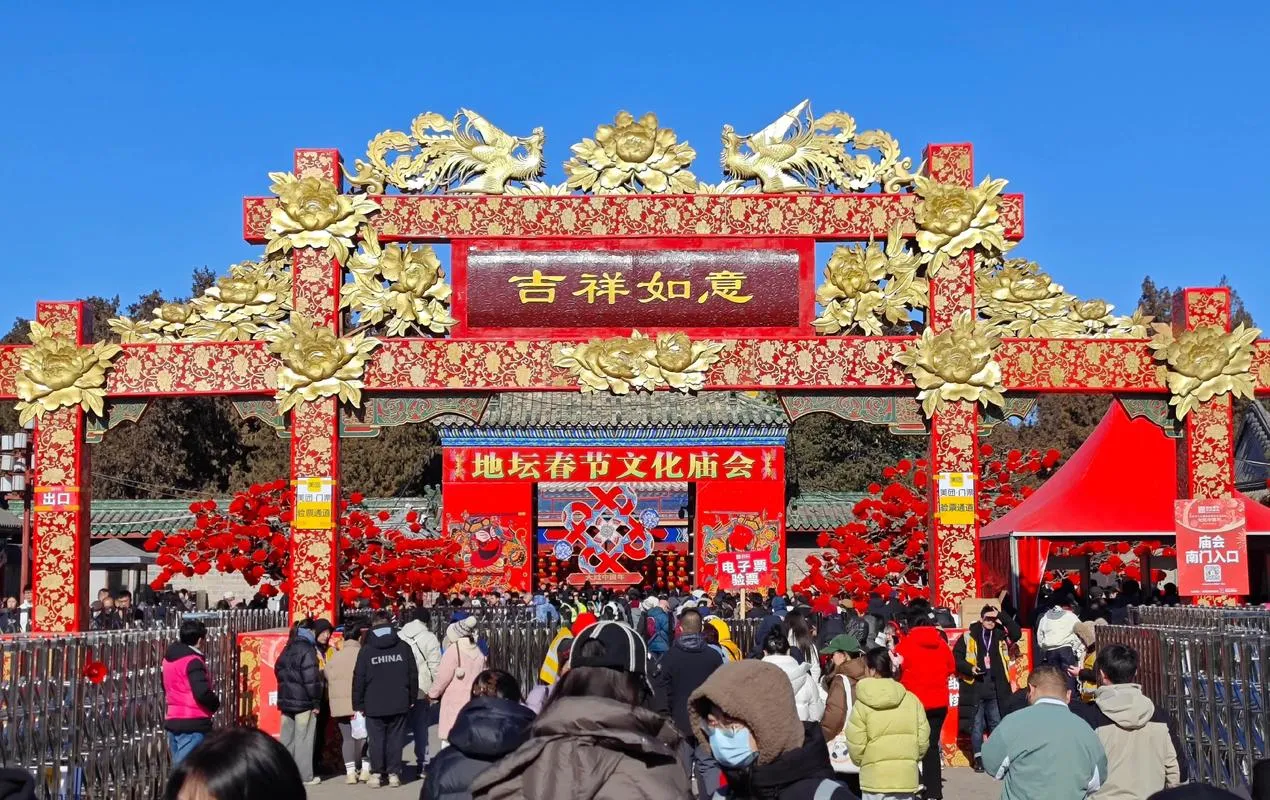 The Ditan Temple Fair, Beijing’s flagship New Year celebration since 1985.
Shanghai, Yuyuan Lantern Festival. The most internationally famous of the New Year displays. In 2026 it ran from 26 January to 3 March — late January right through Lantern Festival, 37 days. The lantern zone has run a “Shanhai Qiyu Ji” (山海奇豫记) series in recent years, whose creatures are drawn from the Classic of Mountains and Seas (Shanhai Jing); the 2026 Year-of-the-Horse zone was titled “Wilds” (旷野篇).
The practical bit English guides omit: the core lantern zone is ticketed and uses timed entry. On peak days (Fridays to Sundays, Days 1–7, and Lantern Festival) it is ticket-only from 14:00 to 22:00; on ordinary days it opens 16:00–22:00. It is closed on New Year’s Eve. Book through the Yuyuan ticketing mini-program; the surrounding Grand Yuyuan area and the city streets are free to walk. Yuyuan’s 2027 theme had not been announced as of September 2026 — organisers typically reveal it in December or January. More on the neighbourhood in our Shanghai travel guide.
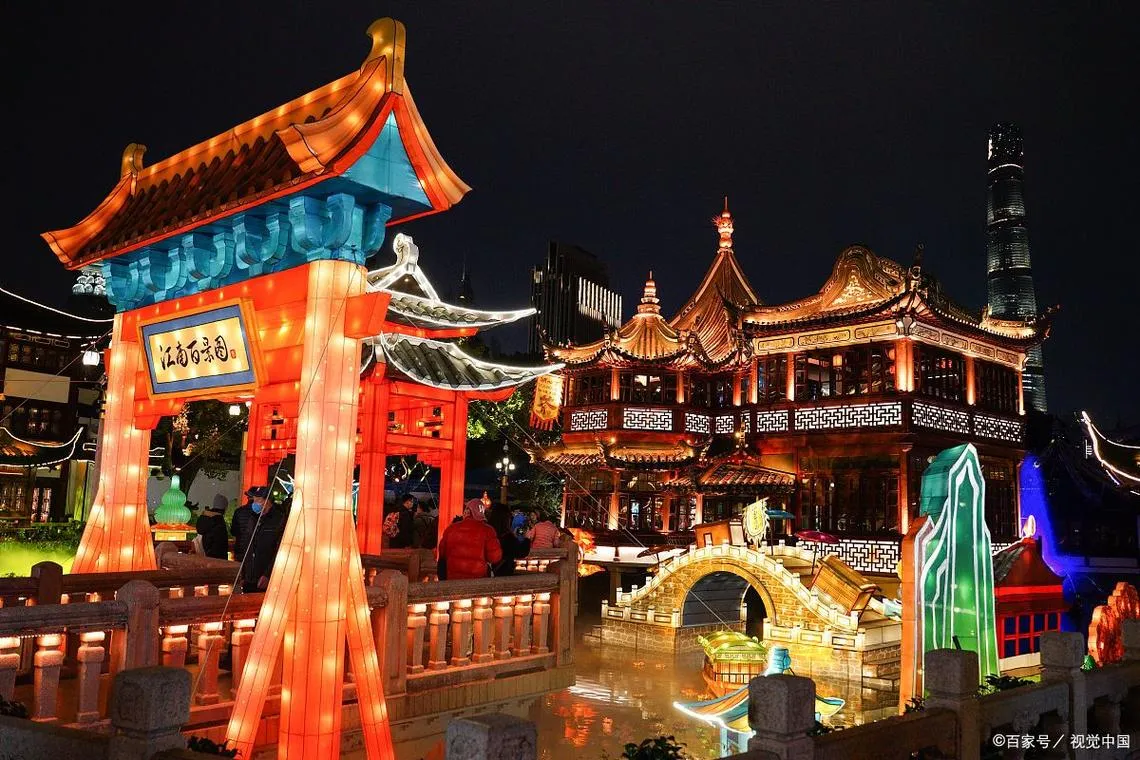 Yuyuan Lantern Festival in Shanghai, lit nightly through Lantern Festival.
Guangzhou, the Spring Festival Flower Markets. “Xing hua jie,” walking the flower market, is the Cantonese New Year ritual: kumquat trees (the word for kumquat sounds like the word for luck), peach blossoms, narcissus. The markets traditionally open in the final days of the twelfth lunar month and run into the small hours of New Year’s Day, when the unsold flowers go cheap.
Be careful with the specifics here. In 2026 the main markets opened on the 26th day of the twelfth lunar month (13 February), not the 28th, at 08:30, and closed at 02:00 on Day 1 (17 February). The traditional custom is the 28th, but recent practice has moved earlier. On crowds: the Tianhe market is the biggest, and the Tianhe district government recorded about 510,000 visits across its four-day run in 2026 — roughly 128,000 a day. (If you see “half a million a day” in an English guide, that is the whole fair being miscounted as a single day.) Dates and locations for 2027 had not been announced as of September 2026; Guangzhou usually confirms them in January. Pair it with our Guangzhou travel guide and Guangzhou food guide.
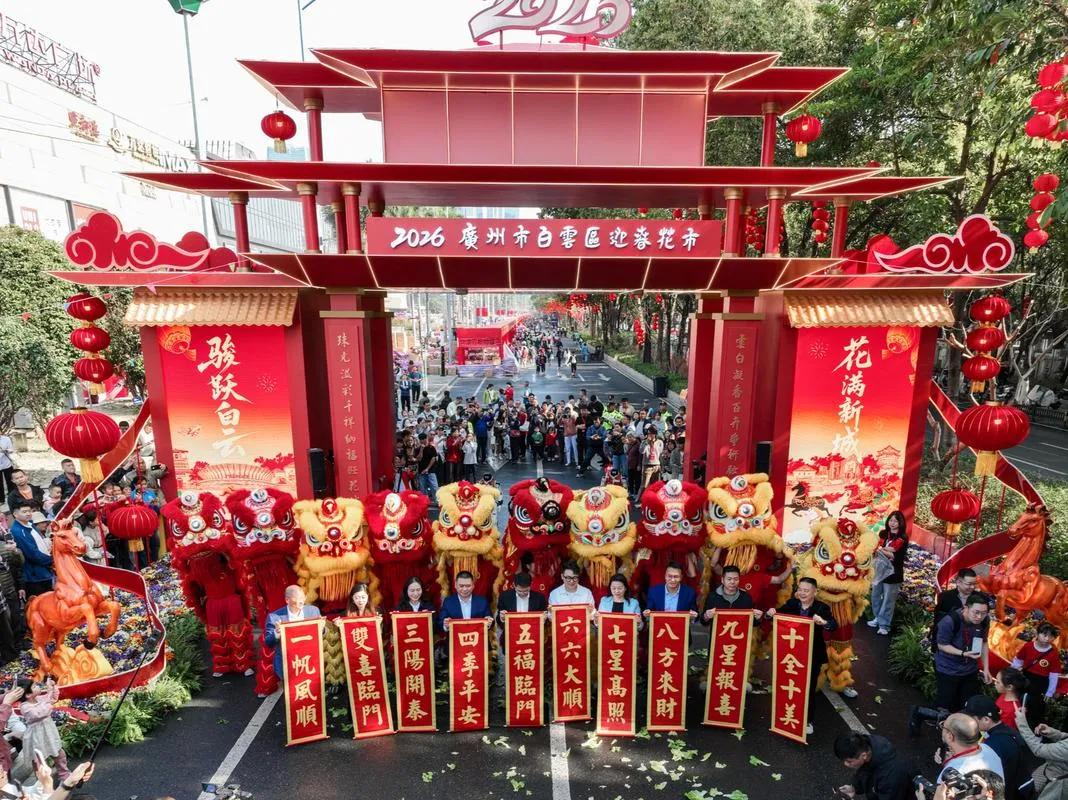 Guangzhou’s Spring Festival flower market — kumquat trees for luck, peach blossoms for prosperity.
Xi’an, Tang Dynasty lights. Two centres of gravity: the Grand Tang Mall (大唐不夜城) pedestrian street and the North Square of the Giant Wild Goose Pagoda. In 2026 the mall launched a 125-day “Chang’an Lantern Festival · Flower Season” starting on Lunar New Year’s Day, built around horse-themed lantern sets and a Tang-dynasty street-performance programme, while the pagoda’s north square ran its music-and-light fountain show several times a day. The 2027 programme had not been announced as of September 2026, but this has been Xi’an’s flagship Spring Festival event for years. See our Xi’an travel guide and Muslim Quarter food guide.
Harbin, a word of caution. Many guides tell you to “see the Ice Festival at Chinese New Year.” That is half true. Harbin International Ice and Snow Festival is, by local statute, opened on 5 January every year — and famously has an opening ceremony but no closing one; in practice the season starts before the new year and runs until the ice gives out, and the city bills it as the world’s longest-running ice and snow festival. So by Chinese New Year the opening ceremonies, fireworks and parades are over. You get the finished product without the opening-night crowds.
But do not assume late February. Ice and Snow World usually opens in mid-to-late December and runs into February — and closes the moment the ice cannot hold it. The 2025–26 season (the 27th) shut on 21 February 2026, earlier than planned, after record-breaking warm weather on 20–21 February. Treat late February as a “check before you book” window, not a guarantee. Details of the 2026–27 season (the 28th) had not been officially announced as of September 2026. For the current picture, see Harbin Ice and Snow World 2026-27 and our Harbin city guide.
 Ice and Snow World in Harbin. The sculptures usually stand into February — but the 2025–26 season closed early on 21 February 2026.
The Food: Reunion Dinner and Red Envelopes
The reunion dinner on New Year’s Eve is the heart of the holiday, and it is a family affair. You cannot book a seat in a stranger’s home. What you can do:
- High-end hotel packages. Five-star hotels (Beijing Hotel, Peace Hotel Shanghai, White Swan Guangzhou) offer reunion dinner sets for outsiders. Book 1 to 2 months ahead; reservations typically open around the end of the preceding year.
- Old-name restaurants. Quanjude for Peking duck, Donglaishun for hot pot, Haidilao, all open through the holiday with special menus.
The food carries meaning. Dumplings, shaped like ancient gold ingots, for wealth. Fish, because the phrase for “fish every year” sounds like “abundance every year,” and you do not finish it; you leave some to carry into the new year. Niangao, the glutinous rice cake, for “higher each year.” In the south, tangyuan — glutinous rice balls in sweet broth — for family togetherness. Our Chinese food guide for foreigners covers the everyday version of all this.
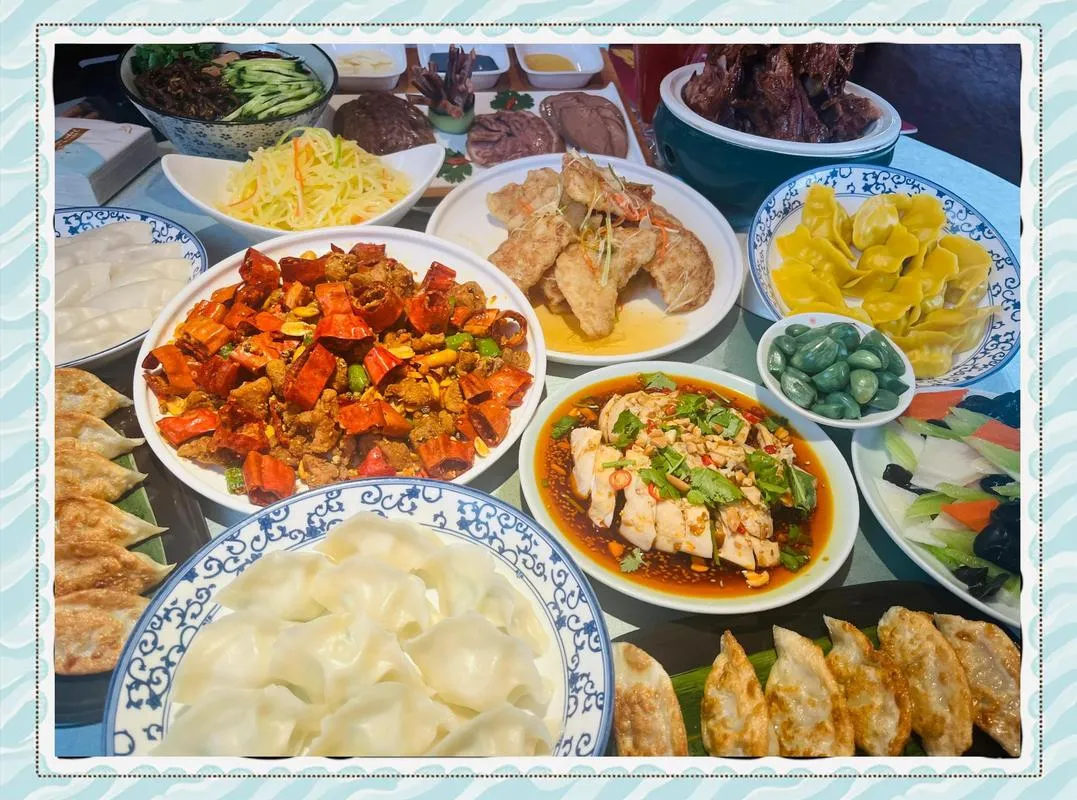 A Chinese New Year’s Eve reunion dinner — dumplings shaped like gold ingots, fish left unfinished for “abundance every year.”
Red envelopes (hongbao). Traditionally elders give them to children after the reunion dinner, past midnight. The custom goes back to the Han dynasty, originally “money to suppress evil.” Today, WeChat red envelopes (since 2014) are how most are sent, and foreigners can join in once WeChat Pay is set up — see How to Use WeChat Pay as a Foreigner.
If you give one, use red, never white. White is for funerals. Avoid amounts with the number 4, which sounds like “death.” Good numbers are 88, 188, 288. And note the regional split: in Cantonese areas the rule is “it is the thought, not the amount,” with 5 to 20 yuan common; in northern China, amounts between elders and children can run 200 to 1,000 yuan and higher.
What It Costs: 2026 Data, 2027 Warning
The 2026 Spring Festival holiday (nine days, 15–23 February) was the biggest on record: 596 million domestic tourist trips and 803.5 billion yuan in tourism spending, both all-time highs, according to the Ministry of Culture and Tourism’s data centre.
On foreign arrivals: during the 2026 holiday, 460,000 foreign arrivals entered under a visa-free policy — a 28.5% rise in daily-average terms versus the 2025 holiday, per the National Immigration Administration. Note the two qualifiers: it is a daily-average comparison (2026’s holiday was 9 days against 2025’s 8), and it counts only those entering visa-free.
Where prices spiked hardest in 2026 — and it was not Sanya.
The biggest surges were in Chaoshan, the Shantou–Jieyang–Chaozhou region of Guangdong, powered by the Yingge dance going viral. Ctrip’s 2026 data put hotel booking growth at 186% year-on-year in Shantou — the highest in the country — with Jieyang at 162% and Chaozhou at 135%.
Those are booking volumes. Room rates are a separate, uglier number. A survey by Shangyou News of listed nightly rates found average increases of 300–600% across the three cities over the 2026 holiday, with a few properties above 700%. One budget property — the Hanting near Chaozhou’s Guangji Bridge — was listed at 179 yuan for a post-holiday night (4 March 2026) and 1,464 yuan for the second day of the festival (18 February), an increase of roughly 718%, about eight times the normal rate. That is a single-property sample and an industry survey, not government statistics.
Elsewhere, booking volumes told the same story: Sanya +112% and Jinghong +109% year-on-year, with Fuzhou, Quanzhou and Xiamen up 80–90% (Ctrip). Again — booking growth, not rate increases. If warm weather is the goal, our Sanya travel guide covers what Hainan costs in peak season.
Authorities pushed back. On 28 January 2026, Shantou’s market regulator and development-and-reform commission jointly issued a formal price warning telling hotels not to “raise prices excessively” or add charges after a booking is confirmed. In Quanzhou, 1,413 hotels and homestays signed public price-integrity pledges ahead of the holiday. The message for you: book 2 to 3 months ahead in any of these hot spots, or pivot.
The contrarian move. In Beijing and Shanghai, high-end hotel rates tend to hold flat or dip during the holiday — some five-star properties run 10–30% below normal — because business travel stops and residents leave town. But hotels near the big sights are the exception: a mid-range property by Tiananmen was up about 50% in 2026. Budget on location, not on city. Compare with the October surge in our National Day Golden Week guide, and see How Foreigners Book Hotels in China for the mechanics.
Your 2027 Countdown Checklist
If you are serious about this trip, here is the timeline. Nothing here needs to happen before October 2026.
October–November 2026
- Watch gov.cn for the State Council 2027 holiday notice. The moment it lands, the real dates are fixed and you can book flights with confidence.
- Confirm your visa path. The 240-hour visa-free transit policy covers 57 nationalities (expanded to 57 on 20 August 2026) across 65 ports in 24 provinces, including Beijing, Shanghai and Guangzhou: fly in, stay up to ten days, fly out to a third country. That is enough for a New Year trip without applying in advance. Full detail in China’s 240-Hour Visa-Free Transit and China Visa-Free Entry in 2026.
December 2026
- Book flights first — international capacity into the festival week is the tightest thing you will face.
- Book hotels 2–3 months out if you are heading anywhere in the Ctrip top-ten list (Chaoshan, Sanya, Jinghong, Fuzhou, Quanzhou, Xiamen). In Beijing and Shanghai you can wait longer, unless you want to be next to a major sight.
- Register and verify your passport on 12306 now. Verification can take hours and you do not want to discover that at 08:00 on 22 January.
- Set up Alipay and WeChat Pay before you fly; see How to Set Up Alipay in China.
January 2027
- 22 January (projected): chunyun begins. Tickets for 6 February go on sale around this date.
- Late January: the Palace Museum publishes its holiday notice — check it. Beijing and Shanghai confirm temple fair and lantern festival dates. Guangzhou confirms flower market dates and locations.
- If you are on the Beijing–Shanghai corridor, consider the 60–17 day reservation pilot as a backup channel.
February 2027
- 5 February: New Year’s Eve. Eat early, everything closes after lunch, Yuyuan is closed, malls shut by 18:00.
- 6 February: Day 1. Museums reopen; malls open late; temple fairs begin.
- 7–9 February: the quiet window. Do the Forbidden City, the Bund, the Great Wall.
- 10–12 February: the return crush. Do not travel if you can avoid it.
- 20 February: Lantern Festival. Last night for the lantern displays.
The Honest Verdict
Chinese New Year is the most demanding week to travel in China. The payoff is festival experiences that exist for two weeks and nowhere else: temple fairs, lantern festivals, a country visibly celebrating. The cost is crowded transport, scaled-back small businesses, and hotel premiums in the trendy spots.
Come if you want the festivities and you are willing to plan around Chunyun. Skip it if you want a relaxed museum-and-restaurant trip; late March or October serves that better.
The 240-hour visa-free transit policy, available to 57 nationalities through 65 ports in 24 provinces including Beijing, Shanghai and Guangzhou, makes a spontaneous New Year trip more feasible than ever. Fly in, stay ten days, fly out. Just do not try to buy a train ticket on February 3.
Sources & Verification
This guide was last verified on 2026-09-24. Key Chinese-language sources:
- 国务院 State Council (gov.cn): the source of the official Spring Festival holiday dates and make-up workdays. The 2026 notice was issued 4 November 2025; the 2025 notice 12 November 2024; the 2024 notice 25 October 2023. The 2027 notice had not been published as of 24 September 2026. The 2024 revision briefing states that when New Year’s Eve falls on a Friday the break can be extended to 9 days, citing 2027 as the example.
- 交通运输部 Ministry of Transport (mot.gov.cn): chunyun totals and the “15 days before, 25 days after” formula. 2026: 9.41 billion trips over 2 February – 13 March, 235 million a day, 79.3% by private car, single-day peak 380 million on 22 February.
- 中国科学院紫金山天文台 Purple Mountain Observatory (CAS): the five-year run of short twelfth lunar months (2025–2029) with no “big year-thirty,” next 30th-day eve in 2030.
- 香港/澳门特区政府 Hong Kong & Macau SAR governments: both have gazetted 6 February 2027 as Lunar New Year’s Day.
- 12306 (China Railway official ticketing): 15-day advance sale counting the departure day; the Beijing–Shanghai reservation pilot from 20 July 2026.
- 北京市人民政府 Beijing Municipal Government: Ditan temple fair dates, hours and the 09:00–09:30 sacrifice reenactment; Longtaitou barber volumes.
- 上海市人民政府 Shanghai Municipal Government: 2026 Yuyuan lantern festival dates (26 January – 3 March), theme, and timed-entry ticketing rules.
- 广州市天河区人民政府 Tianhe district government: 2026 flower market attendance, about 510,000 visits across four days.
- 哈尔滨冰雪大世界 Harbin Ice and Snow World: the 27th season closed 21 February 2026 after record warm weather.
- 故宫博物院 Palace Museum (dpm.org.cn): the 2026 full-day closure on 16 February; 2027 arrangements not yet announced as of September 2026.
- 文化和旅游部 Ministry of Culture and Tourism: 2026 holiday figures — 596 million domestic trips, 803.5 billion yuan, both records.
- 国家移民管理局 National Immigration Administration: 460,000 visa-free foreign arrivals over the 2026 holiday, +28.5% on a daily-average basis; 240-hour transit at 57 countries and 65 ports from 20 August 2026.
- 携程 Ctrip: hotel booking growth for Spring Festival 2026 (Shantou +186%, Jieyang +162%, Chaozhou +135%, Sanya +112%, Jinghong +109%).
Where a figure comes from a commercial platform (Ctrip, Meituan) or an industry survey (Shangyou News) rather than a government statistic, we say so in the text.
See our full verification methodology.
Related Articles
- China’s 240-Hour Visa-Free Transit: who qualifies, which ports, how the 10 days count
- How to Buy China Train Tickets: surviving Chunyun bookings
- Forbidden City Guide: tickets, booking windows and low-season hours
- Harbin Ice and Snow World 2026-27: tickets, the 240-hour visa truth, and when it closes
- National Day Golden Week 2026: the other peak, and how it compares
- Iconic Chinese Dishes and Their Legends: what to eat during the festival