Shigatse Travel Guide (2026): Gateway to Everest Base Camp — the Lhasa Train, Tashilhunpo Tickets, and Why Your Border Permit Isn't a Border Pass
Shigatse is where most English-language Tibet advice stops being useful. Guides describe it as a “stopover on the way to Everest,” which is technically true and practically misleading: the city sits at 3,850 m — higher than Lhasa — it holds the largest monastery in western Tibet, and it is the last place where you can sleep in a properly oxygenated bed before the road climbs toward 5,000 m. Get Shigatse wrong and you get the rest of your Tibet trip wrong. This guide covers the train from Lhasa, the two-permit paperwork that Everest actually requires, Tashilhunpo Monastery’s real ticket and hours, how the Everest base camp visit works in 2026, where to sleep, and the altitude math that decides whether your itinerary is safe. It is the fourth angle in our Tibet series — our Tibet Travel Permit guide covers getting the permit before you fly, our Lhasa travel guide covers arriving and acclimatizing at 3,650 m, and our overnight sleeper-train guide covers the rail journey in. This one is about everything west of Lhasa.
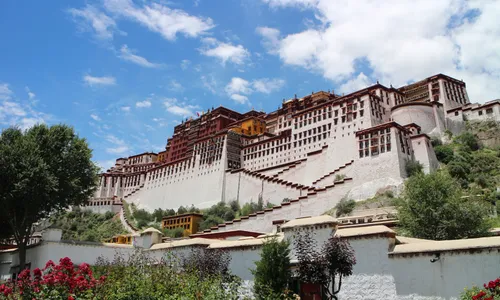
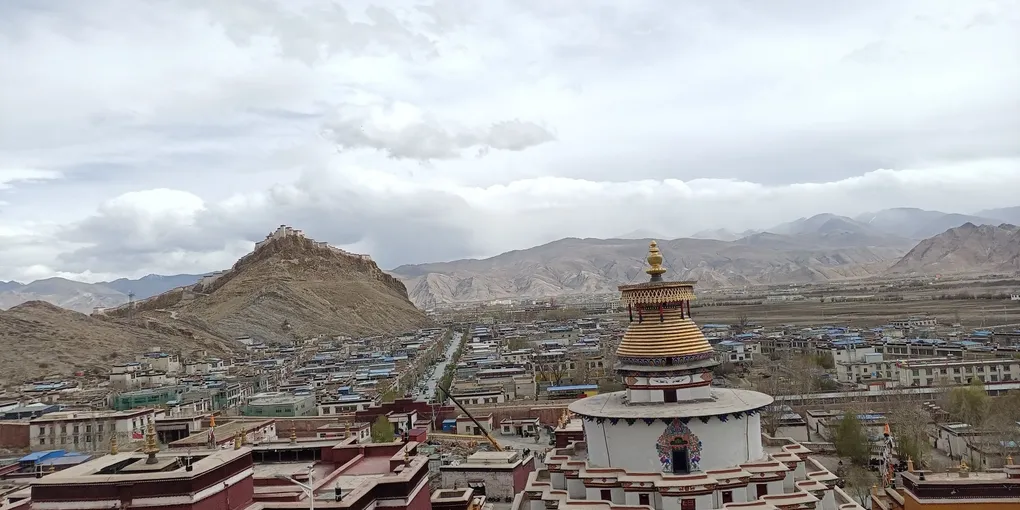
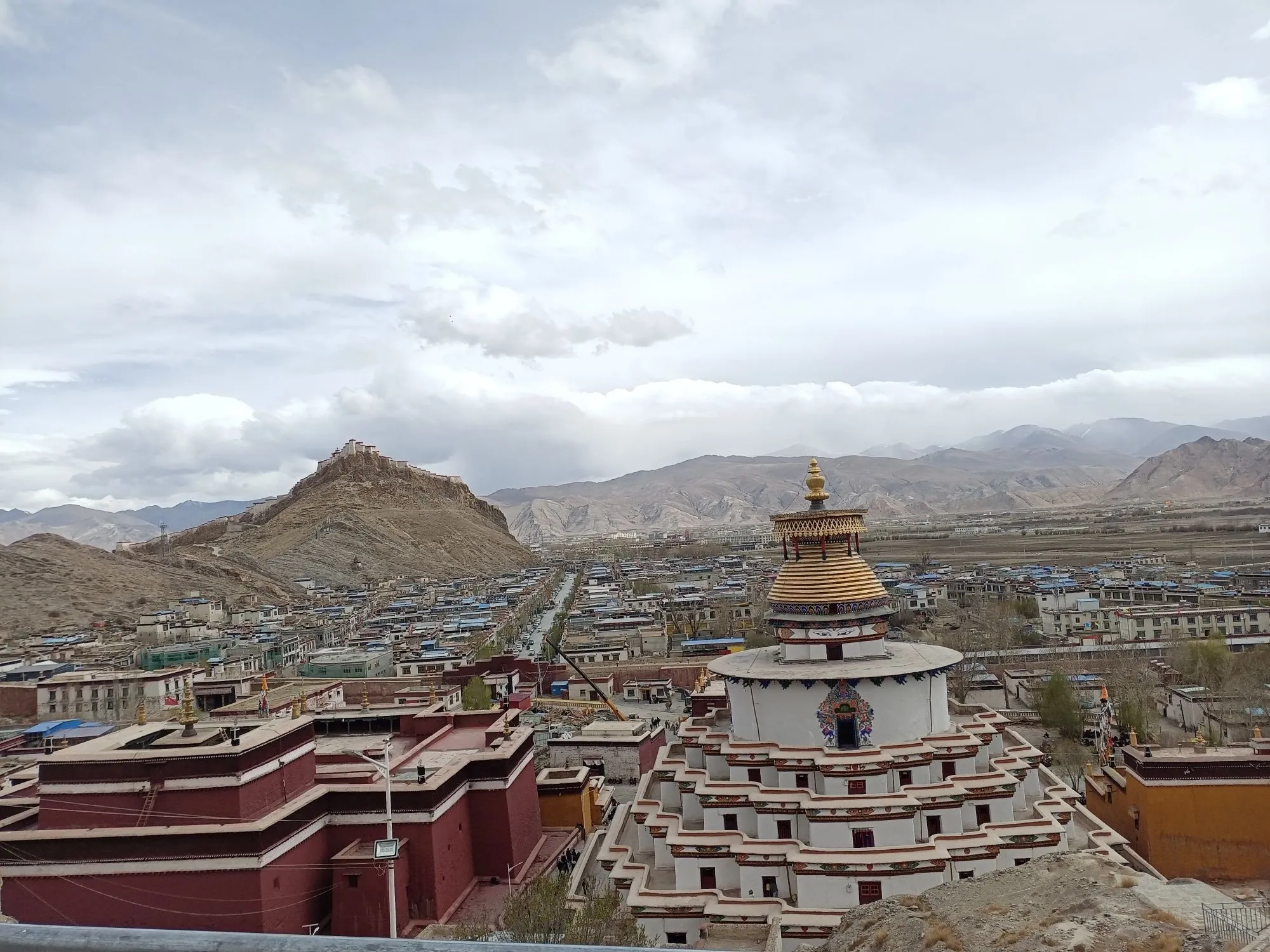 Tashilhunpo Monastery: the seat of the Panchen Lamas, and the reason Shigatse is more than a roadside stop on the way to Everest.
Quick answer: Shigatse is Tibet’s second-largest city at 3,850 m, reachable from Lhasa by Fuxing bullet train in about 2h04m (second class from ¥64, several departures daily) or by a 5–6 hour charter via Yamdrok Lake. Foreign visitors need the Tibet Travel Permit (TTP) — the original document, since March 13, 2026 — and must travel on a licensed group tour. Tashilhunpo Monastery costs ¥100 in peak season (roughly May–October), opens 09:00–17:00 with chapels closed 12:00–14:00, and needs no mandatory advance booking. To continue to Everest Base Camp you need a second document, the Alien’s Travel Permit (ATP), arranged by your agency — not the Chinese-citizen border pass that English blogs keep naming. The Everest visit costs ¥160 + ¥120 (ticket + mandatory shuttle), and the area tourists actually reach sits at 5,000–5,150 m, not the 5,200 m climbing camp.
How we verified this: SinoWander reads the Chinese sources that English guides recycle without checking — the Shigatse municipal government’s Everest scenic-area notice, Tibet’s “Winter in Tibet” ticket announcements, dated 2026 Chinese rail timetables, and licensed Tibet agencies’ current permit pages. We ran deep-search fact-checks on September 15 and again on September 17, 2026, and corrected six points before publishing: the Everest tourist area’s true altitude, the ATP-versus-border-pass distinction, Tashilhunpo’s seasonal pricing, the absence of a mandatory booking system, the 3,850 m city elevation, and the confusion between Shigatse Peace Airport (RKZ) and the new Tingri airport (HNY). Train times and fares change with the timetable — confirm on 12306 before you book. Last verified 2026-09-17. See our methodology.
Shigatse at a Glance: Higher Than Lhasa, and the Only Road to Everest
Shigatse (Xigazê, 日喀则) sits where the Yarlung Tsangpo and Nianchu rivers meet, in the agricultural heartland Tibetans call Ü-Tsang’s western half. Its name means “the estate of supreme happiness.” For six centuries it was the seat of the Panchen Lama lineage and the political counterweight to Lhasa; today it is a prefecture-level city of wide Shanghai-funded boulevards, sweet-tea houses, and one very large monastery on a hillside.
| Lhasa | Shigatse | |
|---|---|---|
| Elevation | 3,650 m | 3,850 m |
| Role | Capital, arrival hub | Everest gateway, Tsang cultural center |
| Headline sight | Potala Palace | Tashilhunpo Monastery |
| From Lhasa | — | 2h04m by train / 5–6h by road |
| Oxygen in hotels | Common | Effectively standard |
The 200-meter difference sounds trivial and isn’t. Oxygen availability drops non-linearly with altitude, and the jump from Lhasa to Shigatse is the kind that produces a headache in people who felt fine 48 hours earlier. Add the onward drive to Everest — which climbs another 1,200 m in a single day on the classic two-day itinerary — and Shigatse’s real job becomes clear: it is your last comfortable night before the thin air, not a place to rush through.
Mount Everest (8,848.86 m) stands in Tingri County, administratively inside Shigatse prefecture. That is the whole reason the city is on your itinerary.
The Paperwork: TTP Plus the Alien’s Travel Permit — and Why “Border Pass” Is the Wrong Word
This is the section English guides most often get wrong, so we’ll be precise about terms.
You need the TTP to be in Shigatse at all. Any foreign passport holder (including overseas Chinese traveling on a foreign passport) and Taiwan compatriots must hold a Tibet Travel Permit, issued by the Tibet tourism authority through a licensed Tibet agency. Since March 13, 2026, flights and trains into Tibet check the physical original — photocopies, PDFs, and screenshots are rejected. You cannot apply yourself, you cannot travel independently, and you cannot self-drive. The full who-needs-what breakdown is in our Tibet permit guide.
Shigatse city itself needs nothing extra. If your itinerary is Lhasa → Shigatse → back, the TTP is enough. Tashilhunpo Monastery and the city sights check the TTP only.
Everest needs a second document: the Alien’s Travel Permit (ATP). Everest Base Camp lies in Tingri County, which is a border-controlled area. Foreigners therefore need the Alien’s Travel Permit (外国人旅行证) in addition to the TTP — arranged by your agency through the public-security bureau, with an official fee of roughly ¥50 per person. Chinese agencies frequently call this a “border pass” (边防证) in casual Chinese, and English blogs copy the term. Don’t let that confuse you: the 边防证 / Border Management Area Pass is the document Chinese citizens obtain, and since April 15, 2026 mainland residents aged 16+ can apply for an electronic version through the 12367 immigration app. That channel does not apply to foreign passport holders. You get the ATP through your agency, and your agency gets it as part of the Everest itinerary filing.
Practical consequence: you cannot decide to add Everest on the morning you arrive in Shigatse. The ATP is filed with the itinerary in advance, which means your Everest plan must exist before you leave Lhasa. If Everest is even a possibility, tell your agency during booking.
What the tour obligation means in practice. Foreign visitors in Tibet move on an agency’s vehicle with a certified guide, on a filed itinerary. Within Shigatse city you can walk and take taxis freely. The moment you leave — to Gyantse, Tingri, Everest, Sakya — the tour vehicle is mandatory. Every “rent a car and drive to Everest” post you have read is describing something not available to foreign passport holders.
Getting to Shigatse: Train, Charter, or (Rarely) Flight
The bullet train — the default answer
The Lhasa–Shigatse railway (an extension of the Qinghai–Tibet line) has run Fuxing high-altitude bullet trains since May 19, 2025, replacing the old Z-series sleepers on this route. The fastest runs take about 2 hours 4 minutes; other departures run 2h17m–2h21m.
- Second class ¥64, first class ¥103, business class ¥225 (fares as listed in 2026).
- Roughly six to nine departures a day in each direction, including C885 (morning), C887 (early afternoon) and C883 (late afternoon), plus additional C-series trains added at peak times. Times shift with every timetable change — check 12306 or your agency for your date. Booking works like any Chinese rail ticket; see our train-ticket guide.
- The line crosses the Lhasa River and the Yarlung Tsangpo and runs through the northern Tibetan grasslands — sit on the right for the river scenery.
- Shigatse railway station is about 7 km from the center; a taxi to Tashilhunpo runs roughly ¥15. There is also a tourist bus service.
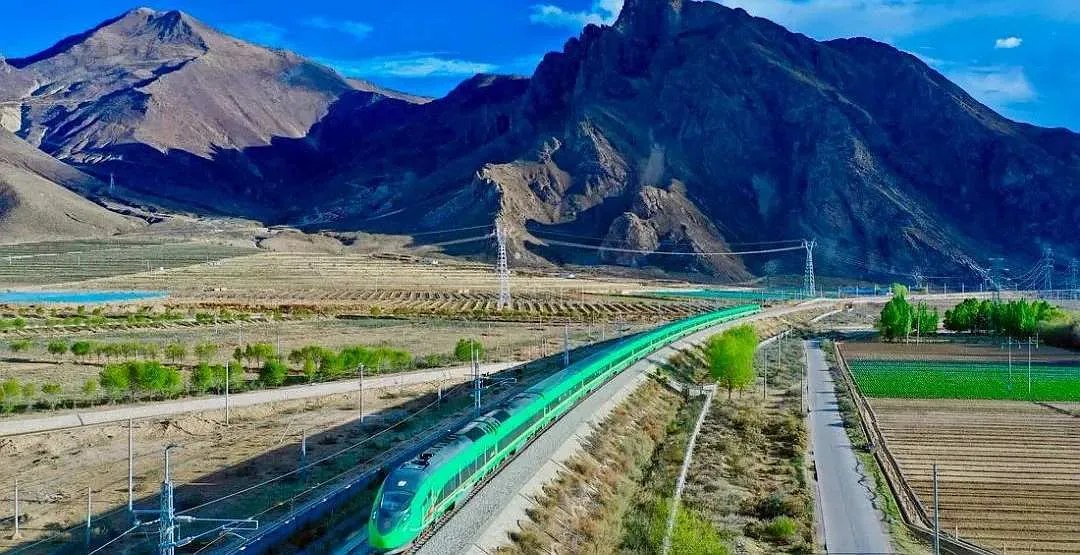 The Lhasa–Shigatse railway: about two hours, oxygen-equipped, and the gentlest way to gain 200 metres.
The train is also the gentler altitude choice: you gain elevation gradually and the carriages are oxygenated, the same reason we recommend the sleeper train for the approach into Tibet itself.
Charter car — the scenic option (mandatory for most itineraries anyway)
Lhasa → Shigatse is about 270–280 km; with stops at Yamdrok Lake and the Karola Glacier it becomes a full 5–6 hour day. A private car runs roughly ¥800–1,000 per vehicle in low season, more in summer. For foreign travelers this isn’t a budget choice — it’s how the tour works. Your agency’s vehicle is the only legal way to make the overland trip, and the Yamdrok stop is the scenic highlight of the drive.
Flying — two airports, and they are not the same place
Two airports now serve this region, and confusing them is easy:
| Airport | Code | Where | Status (2026) |
|---|---|---|---|
| Shigatse Peace Airport | RKZ | ~43 km from Shigatse city, elevation 3,783 m | Chengdu Shuangliu (CTU) ⇄ RKZ, roughly one daily Tibet Airlines flight (TV9976 inbound / TV9975 outbound) |
| Tingri (Everest) Airport | HNY | Tingri County, much closer to Everest | Chengdu Tianfu ⇄ Tingri (resumed April 17, 2026) and Lhasa ⇄ Tingri (opened September 5, 2026, Tue/Thu/Sat) |
Both require the TTP original at check-in, and both still leave you dependent on the agency’s vehicle for the onward transfer — flying in does not bypass the tour requirement. For most travelers, flying into Lhasa Gonggar (LXA) and continuing by train or road remains simpler. If you are short on days and heading straight to Everest, ask your agency about the Lhasa ⇄ Tingri service.
Tashilhunpo Monastery: Tickets, Hours, and What to See Inside
Founded in 1447 by Gendun Drub (the First Dalai Lama), Tashilhunpo is the largest Gelug monastery in Tsang, the traditional seat of the Panchen Lamas, and a national 5A scenic area. It covers roughly 150,000 m² across a hillside of white walls, red chapels, and gold roofs. Plan 3–4 hours.
Tickets, hours, and booking:
| Item | Detail |
|---|---|
| Peak-season ticket | ¥100 (roughly May 1 – Oct 31) |
| Off-season ticket | ~¥50 (a few official listings show ¥55 — budget ¥50–55) |
| Tibetan pilgrims | Free |
| ”Winter in Tibet” campaign | Ticket halved again during the winter promotion window |
| Hours | Officially 09:00–17:00; some OTA listings show 09:00–18:30 in summer |
| Chapel closure | 12:00–14:00 — the main chapels shut for the midday break |
| Advance booking | No mandatory system we could find in official notices; buy on site. Several 2026 Chinese guides advise booking 1–2 days ahead in peak season — sensible, not required |
That last row matters because Tashilhunpo is not the Potala. The Potala Palace operates a timed-quota WeChat booking system with no same-day sales; Tashilhunpo does not, and English guides that carry the Potala’s rules over to Shigatse cause people to over-plan. Treat on-site purchase as the default and confirm with your guide in peak months.
What to see, in walking order:
- Tsogchen (Main Assembly Hall) — the monastery’s oldest hall, with a gilded Sakyamuni image and the imperial gifts bestowed on successive Panchen Lamas.
- Jampa (Maitreya) Chapel — the signature sight: a 26.2 m gilded copper seated Maitreya, shoulders 11.5 m wide, ears 2.2 m long, studded with diamonds and thousands of pearls, amber, and coral. Interior stairways let you climb alongside the statue to face level.
- Tashi Langyar / the Panchen stupa halls — including the Tenth Panchen Lama’s memorial stupa, built of granite with walls 1.83 m thick and rated to withstand magnitude-8 quakes.
- The Thangka Wall (sunning platform) — 32 m high, founded by the First Dalai Lama, used once a year for the Buddha-unfurling festival; the rest of the year it doubles as the best viewpoint over the city’s gold roofs.
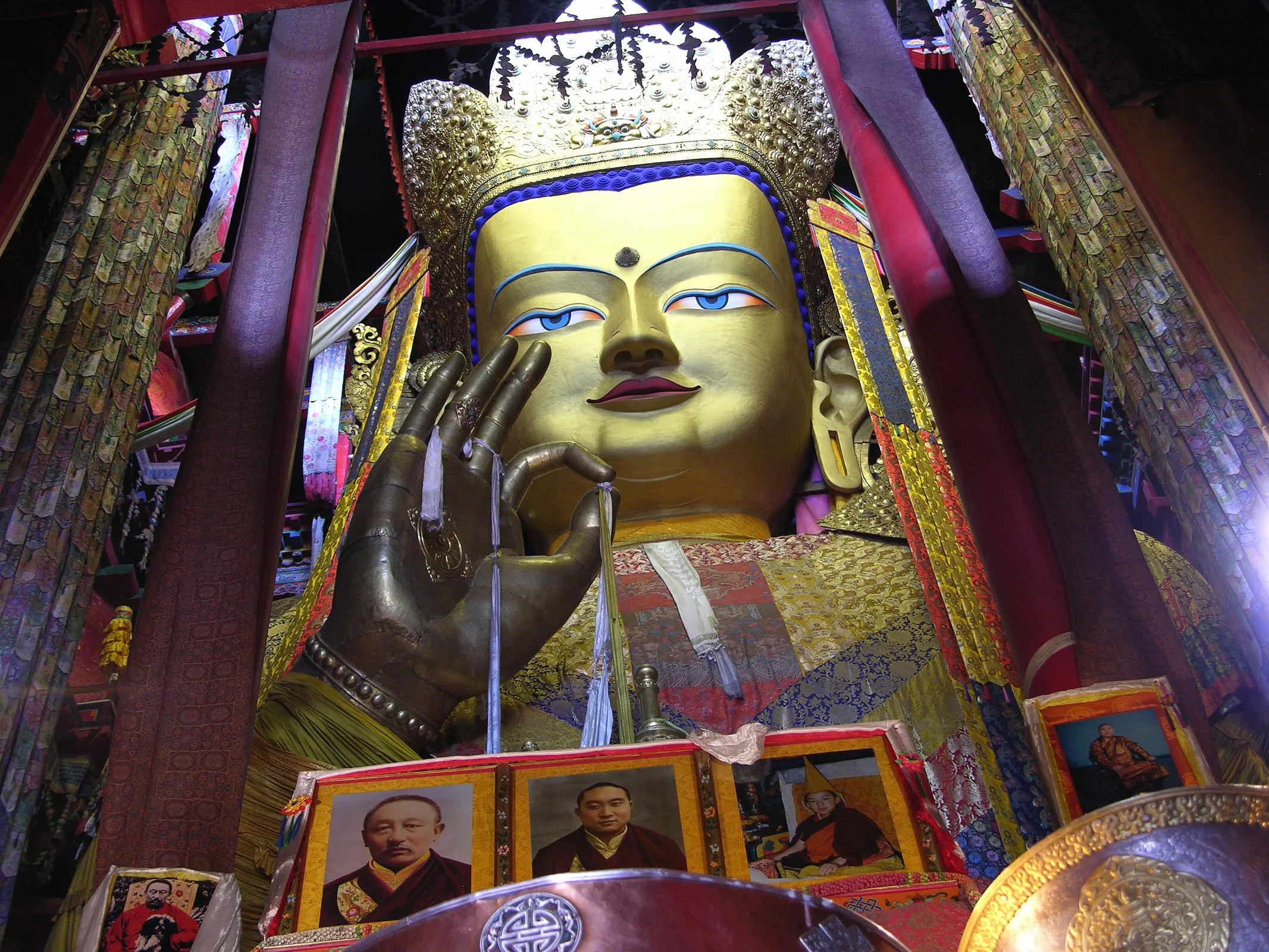 The Jampa Chapel’s 26.2-metre gilded Maitreya — interior stairways let you climb to face level.
Etiquette and documents. Bring the TTP original — it is checked at the gate. Walk the circuit clockwise, keep your voice down, and do not photograph Buddha images inside the chapels (the exterior courtyards and the rooftops are fine). The stalls outside the entrance are where the local food is, which brings us to the next section.
Everest Base Camp from Shigatse: How the 2026 Visit Actually Works
Shigatse → Everest is about 340 km and 6–7 hours including the transfer. Here’s the sequence, and the three things most visitors get wrong.
1. Tickets. Peak-season entry is ¥160 per person (off-season, roughly November–March, ¥80), plus the ¥120 mandatory shuttle bus, which has no seasonal discount. During the annual “Winter in Tibet” promotion (typically November 1 – March 15) the entry ticket is waived but the ¥120 shuttle still applies. Confirm the exact window for your dates with your agency — it is announced yearly.
2. The shuttle is not optional. Since August 2023, private cars cannot drive to the base camp. All visitors transfer to electric shuttle buses at the transfer center in Zhaxizong Township, and the old ¥320 per-vehicle environmental fee was abolished at the same time. Any post telling you to drive to the base camp is describing a pre-2023 reality.
3. The altitude you’ll actually experience — 5,000–5,150 m, not 5,200 m. This is the error we find most often in English guides. The tourist area sits near Rongbuk Monastery at roughly 5,000–5,150 m, where the viewing marker and the tent camp are. The frequently quoted 5,200 m figure is the climbing expedition camp, which ordinary visitors cannot enter. It sounds like a 100-meter quibble; at that altitude it is the difference between a manageable night and a miserable one, and it matters when you compare your itinerary against an insurance policy’s altitude cap — see our China travel insurance guide for the caps on the major plans.
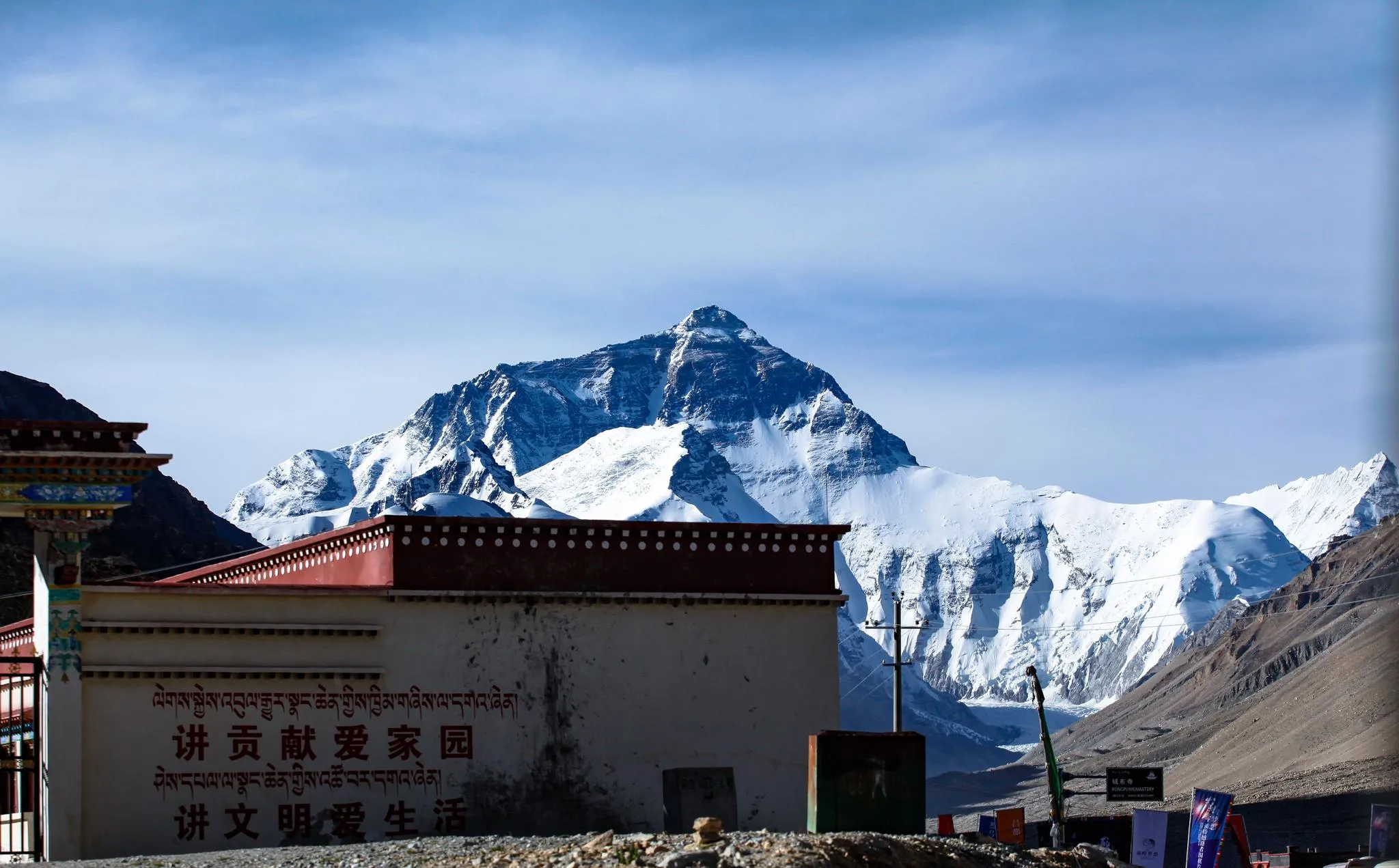 The view from the tourist area near Rongbuk: this is where visitors actually stand, at about 5,000–5,150 m.
The three gates. The scenic area has three entrances (north, east, west), all funnelling to the same shuttle transfer. The North Gate (北大门) on the G318/G219 near Baiba village in Tingri is the main one — about 96 km from the base camp, at 4,340 m, open 24 hours with ticketing, parking, food, oxygen, and emergency services.
Sleeping at the base camp. You can stay overnight. Options: the Rongbuk tent camp (expanded in June 2025 to 54 tents / 416 rooms / 680 beds, about 1 km from the viewing marker), the Rongbuk Guesthouse at roughly 5,100 m (reopened after its 2024 rebuild), or — the choice we’d make for a first Tibet trip — down at Zhaxizong or Yingsong village, where you sleep 400–600 m lower. Sleeping above 5,000 m on your first week in Tibet is how altitude sickness turns a trip into an evacuation.
Beyond the City: Gyantse, Sakya, and Where Foreigners Can’t Go
Gyantse (江孜), about 90 km / 1.5 hours. Called the “hero city” for the 1904 resistance against the British expedition — the site is Gyantse Dzong (the fort, ~¥30, elevation ~4,000 m, and the setting of the film Red River Valley). The other reason to come is Palkor Chode Monastery (¥60, 09:00–19:00), unusual for housing three Tibetan Buddhist schools side by side, with the famous Kumbum stupa whose chapels are built into its tiers. Pala Manor is nearby. Gyantse is a standard stop on the Lhasa–Shigatse overland route.
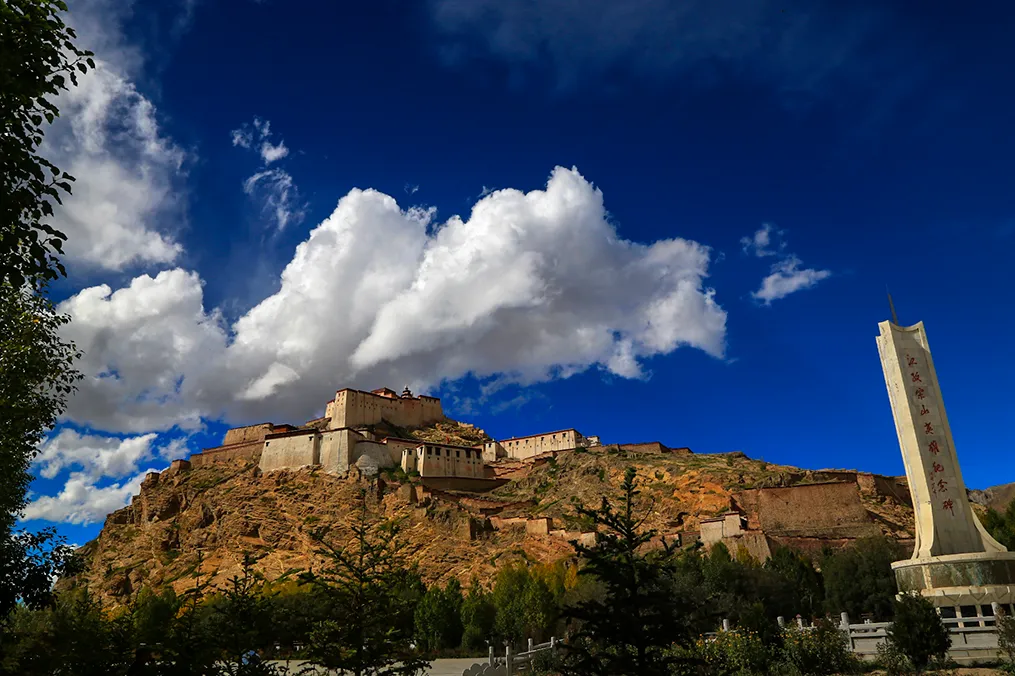 Gyantse Dzong: the 1904 resistance site, and the standard stop between Lhasa and Shigatse.
Sakya Monastery, about 150 km. The Sakya school’s mother monastery, sometimes called the “Dunhuang of the snowlands” for its library and murals. Worth the detour for anyone interested in Tibetan Buddhism rather than just peaks; arrange it through your agency.
Where you probably can’t go. Yadong county (including the Nathu La pass area) and the Zhangmu border crossing are restricted for foreign visitors, and in practice are usually off the itinerary entirely. Everest and Ngari are permitted with the ATP and an agency; these are not. Rules shift — let your agency tell you what is approvable for your dates rather than planning around a blog post.
Where to Stay
At 3,850 m, oxygen is the amenity that matters, not the thread count. Most mid-range and above hotels in Shigatse advertise diffuse oxygen systems (弥散式供氧) plus humidifiers; book one.
- Hilton Shigatse — the city’s best-known international property, Tibetan-design interiors, close to Tashilhunpo (~4.8/5 on Chinese booking platforms).
- Home Inn Select (oxygen) / 如家商旅供氧酒店, Zanglong Square — mid-range with in-room oxygen (~4.6/5).
- Wanxin Zhige / 万信至格 and Yunzuo Xingguang / 云左星光 — mid-range with oxygen; the latter includes a Tibetan-noodle breakfast (~4.5–4.6/5).
On the Everest road: Tingri has a small cluster of oxygen hotels (e.g. Dingri Yingshanhong Kangyang, ~4.7/5), which is the sensible place to break the drive. At the base camp itself, choose between the Rongbuk tent camp, the Rongbuk guesthouse, or the lower villages as described above.
Food and Plateau Reality
Shigatse is a working Tibetan city with a large Sichuanese presence, so the food is better than first-time visitors expect. Street-level prices reported in 2026: Tibetan noodles ¥8, “pengbi” ¥5 (a pea-starch jelly with chili dressing sold at stalls outside Tashilhunpo, and a registered local intangible-heritage snack), Gangba hand-pulled mutton ¥30, sweet tea ¥3, curd buns ¥5. Sit-down Tibetan restaurants and Sichuan places are everywhere in the center; the monastery’s surrounding streets are the cheapest place to eat.
Altitude discipline, restated because Shigatse is where it gets tested. No alcohol and no shower on arrival day, 2–3 liters of water, slow movement, and no strenuous activity for the first 24 hours. Sun at this altitude is fierce — SPF50+, sunglasses, lip balm. Nights are cold even in July; bring a shell and a down layer. If symptoms escalate to vomiting, chest tightness, or unsteady gait, descend and seek oxygen; pink frothy sputum or confusion is a medical emergency.
Money and connectivity. WeChat Pay and Alipay work across the city (see our how to pay in China guide and WeChat Pay guide). Carry cash for Tingri and the Everest road — mobile coverage thins out and terminals fail. Download offline maps before you leave Shigatse. For data, see our SIM vs eSIM guide.
Sample Itineraries
Shigatse in a day (no Everest). Bullet train from Lhasa (2h04m) → Tashilhunpo Monastery (3–4 hours, avoiding the 12:00–14:00 chapel closure) → lunch at the stalls outside → Samzhubtse Dzong for the city view → evening train back. Ambitious but doable if you’ve already acclimatized in Lhasa.
Everest in two days (the classic). Day 1: Lhasa → Yamdrok Lake → Karola Glacier → Gyantse → Shigatse (5–6 hours of driving with stops), overnight in Shigatse. Day 2: Shigatse → Tingri → North Gate → shuttle → Everest tourist area (5,000–5,150 m) → return to Shigatse or push on to Lhasa. This is tight; the second day is a long one at altitude.
Everest in three days (what we’d actually recommend). Day 1: Lhasa → Shigatse by train or road; afternoon at Tashilhunpo, early night at 3,850 m. Day 2: Shigatse → Tingri → North Gate → shuttle → Rongbuk; sleep at the tent camp or, better, at Zhaxizong. Day 3: sunrise at the viewing marker, then the long drive back. The extra day is what turns Everest from a photo stop into something you can actually enjoy.
Budget-wise, a Shigatse day costs roughly ¥100–150 in tickets plus meals, while the Everest leg adds ¥280 per person in fees (¥160 + ¥120) before transport and lodging. For overall trip budgeting see our backpacking China guide.
Shigatse FAQ
Can foreigners visit Everest Base Camp in China? Yes, but not independently. You need the TTP plus the Alien’s Travel Permit (ATP), both arranged by a licensed Tibet agency, and you travel on their vehicle with a guide.
How do I get from Lhasa to Shigatse? The Fuxing bullet train takes about 2h04m, from ¥64 second class, with several departures daily. Driving takes 5–6 hours with lake and glacier stops, and for foreigners the agency’s vehicle is the only legal option.
Is the “border pass” the same as the Alien’s Travel Permit? No. The border pass (边防证) is for Chinese citizens, who can now apply electronically. Foreigners get the Alien’s Travel Permit (ATP) through their Tibet agency, with an official fee around ¥50 per person.
How much are Everest Base Camp tickets? ¥160 entry in peak season (¥80 off-season) plus the ¥120 mandatory shuttle. During the winter promotion window the entry fee is waived; the shuttle fee is not.
How high is the Everest Base Camp that tourists visit? About 5,000–5,150 m near Rongbuk Monastery. The widely quoted 5,200 m figure is the climbing expedition camp, closed to ordinary visitors.
Do I need to book Tashilhunpo in advance? No mandatory booking system exists as of our September 2026 check — buy at the gate. In peak season some 2026 Chinese guides suggest booking 1–2 days ahead; ask your guide.
Is Shigatse higher than Lhasa? Yes — 3,850 m versus 3,650 m. That extra 200 m is why oxygen-equipped hotels are standard here.
The Takeaway for Foreign Visitors
Five things decide whether Shigatse works: (1) the TTP original gets you into the city and into Tashilhunpo, but (2) Everest needs a second document — the ATP, filed in advance, so decide on Everest at booking time, not on arrival; (3) the 2h04m bullet train from Lhasa is the easiest, gentlest way in, with several departures a day from ¥64; (4) the Everest visit costs ¥280 per person and includes a mandatory shuttle — you will not drive yourself to the base camp, and the altitude you’ll actually stand at is 5,000–5,150 m; (5) Shigatse at 3,850 m is where altitude discipline starts to matter, so sleep with oxygen and give yourself a night before climbing higher. Plan the paperwork with our Tibet permit guide, acclimatize with our Lhasa guide, and check that your policy covers 5,000+ m with our travel insurance guide.