Harbin in Winter (2026-27): A City Guide Beyond the Ice Park
Harbin in Winter (2026-27): A City Guide Beyond the Ice Park
Every December a Chinese city of nearly ten million people in the far north stops pretending it is a normal place to live and builds a second one out of river ice. Harbin (哈尔滨) is the capital of Heilongjiang, roughly 1,200 km north-east of Beijing, and from late December to late February it lives somewhere between −10 °C and −30 °C. Foreign visitors arrive for one park. Most leave surprised that the park was only half of the trip.
This guide is the other half. Harbin Ice and Snow World — the ticketed ice park — has its own dedicated guide covering prices, the reservation system, what is bundled into admission, and what a warm winter does to closing dates. Read that for the park: Harbin Ice and Snow World 2026-27.
What follows is the city around it. Two major ice events cost nothing. One apparently obvious winter activity is illegal. The visa that lets you into Harbin quietly expires at the city boundary, which matters enormously if you were planning to sleep in a snow village. And the single most useful fact for planning your days is not the temperature at all — it is that in December the sun sets at four in the afternoon.
How we verified this: SinoWander works from Chinese-language sources English guides do not read: the Harbin municipal government, the Heilongjiang provincial government, the Ministry of Culture and Tourism’s festival filings, the National Immigration Administration, Harbin Public Security Bureau notices, Harbin Customs, and park operators’ own channels. Prices marked (OTA) come from ticketing platforms rather than officials, and we say so. Every guide carries its own verification date: 2026-09-23. We have not personally visited every venue listed. See our methodology.
Quick answer: is it worth the cold?
| Question | Answer |
|---|---|
| How many days? | 3 full days covers the city plus one ice-park evening. 4–5 days if you want Ice and Snow World and the Snow Expo and the free ones. |
| Worth it? | Yes, if you want the one genuinely singular Chinese winter experience. No, if you dislike cold — there is no version of this trip that is warm. |
| When? | Mid-January to mid-February for complete builds with slightly lighter crowds. See When to go. |
| Budget ballpark | Ice and Snow World ~¥328, Snow Expo ~¥198, city sights mostly free, mid-range double in snow season roughly 30–50% above its off-season rate. |
| Biggest risk | A warm spell. The 52nd Zhaolin ice lantern show closed on 19 February 2026 because temperatures rose. Book refundable. |
The whole city in one page
Harbin straddles the Songhua River, which freezes solid enough to harvest for building blocks and stays that way from late November to early April (ice thickness typically 1.2–1.5 m). The city’s Russian character is not a theme-park invention: it began with the Chinese Eastern Railway in 1898, and the émigrés who followed are why a Chinese provincial capital has onion domes and sells dense rye-adjacent bread.
The municipality administers 9 districts, 7 counties and 2 county-level cities, but a visitor needs exactly four:
| District | You are here for | Notes |
|---|---|---|
| Daoli (道里) | Central Street, Saint Sophia, Zhaolin Park, the riverfront, Flood Control Monument | Where first-time visitors should sleep |
| Daowai (道外) | Chinese Baroque old town, old-school restaurants | Cheap eating, few tourists |
| Nangang (南岗) | Harbin station, Qiulin, Gogol Street, Harbin Museum | Ordinary Chinese city life |
| Songbei (松北) | Sun Island, Ice and Snow World, Grand Theatre, Siberian Tiger Park | Across the river; where the ice is |
Nearly everything a first-timer wants is in Daoli and within walking range of Central Street. Songbei is where you go deliberately, on Metro Line 2.
One more thing worth knowing before you plan anything: this city gets dark early. Around the winter solstice sunrise comes at roughly 07:11 and sunset at 15:51; December sunsets fall between 15:48 and 15:59, giving about 8 hours 40 minutes of daylight. Every outdoor plan has to fit inside that window — and it is also why the ice parks look so good in photographs, since most of your visit happens after dark.
Five winter events, and the two that cost nothing
English coverage collapses Harbin’s entire winter into one phrase, “the Ice Festival,” which is rather like calling Edinburgh in August “the Fringe.” Five distinct things run in parallel, they are organised by different bodies, and two of them are free.
| Event | What it actually is | Where | 2025-26 baseline | 2026-27 status |
|---|---|---|---|---|
| China·Harbin International Ice and Snow Festival (中国·哈尔滨国际冰雪节) | A citywide festival, begun 1985 — not a ticketed venue. Opens every year on 5 January | Whole city; opening ceremony inside Ice and Snow World | 42nd opened 2026-01-05 | 43rd not yet announced |
| Harbin Ice and Snow World | The paid ice park. Full detail in our dedicated guide | Songbei, west of Sun Island | 27th edition, opened 2025-12-17 | 28th not yet announced |
| Sun Island International Snow Sculpture Art Expo (雪博会) | Snow sculpture, the daytime counterpart to the ice park. Same island, separate ticket | Sun Island | 38th opened 2025-12-27; ¥198 standard / ¥128 concession; 09:00–17:00, last sale 16:00 | 39th not yet announced |
| Zhaolin Park Ice Lantern Show (兆麟公园冰灯) | Free. China’s original ice lantern garden — the tradition started here in 1963 | Zhaolin Park, Daoli | 52nd opened 2025-12-30, closed early 2026-02-19 as temperatures rose; 10:00–21:00, no reservation | 53rd not yet announced |
| Songhua River Ice-Snow Carnival (松花江冰雪嘉年华) | Free. Around 60 ice activities built on the frozen river beside the Flood Control Monument | On the river ice (see the safety note below) | 8th opened 2025-12-25; roughly 1.45 million m²; 09:30–21:00, no reservation | 9th not yet announced |
Three practical points fall out of that table.
The festival is not something you buy a ticket for. It is the umbrella brand everything else runs under. When someone says they are “going to the Ice Festival,” ask which of the five.
The free ones are genuinely good. Zhaolin is where ice lanterns were invented, it sits in Daoli ten minutes from Central Street, it needs no reservation, and it costs nothing. Several hundred ice installations went up for the 52nd edition. If you are travelling on a budget, or just want one evening that does not involve a ¥328 gate, do your ice at Zhaolin and save the park for another night.
All of it is provisional. As of today, the 2026-27 editions, dates and prices for all five are unannounced. Treat every figure above as a 2025-26 baseline and re-check nearer departure. That is not hedging: Harbin’s ice industry genuinely cannot confirm a season until the cold does.
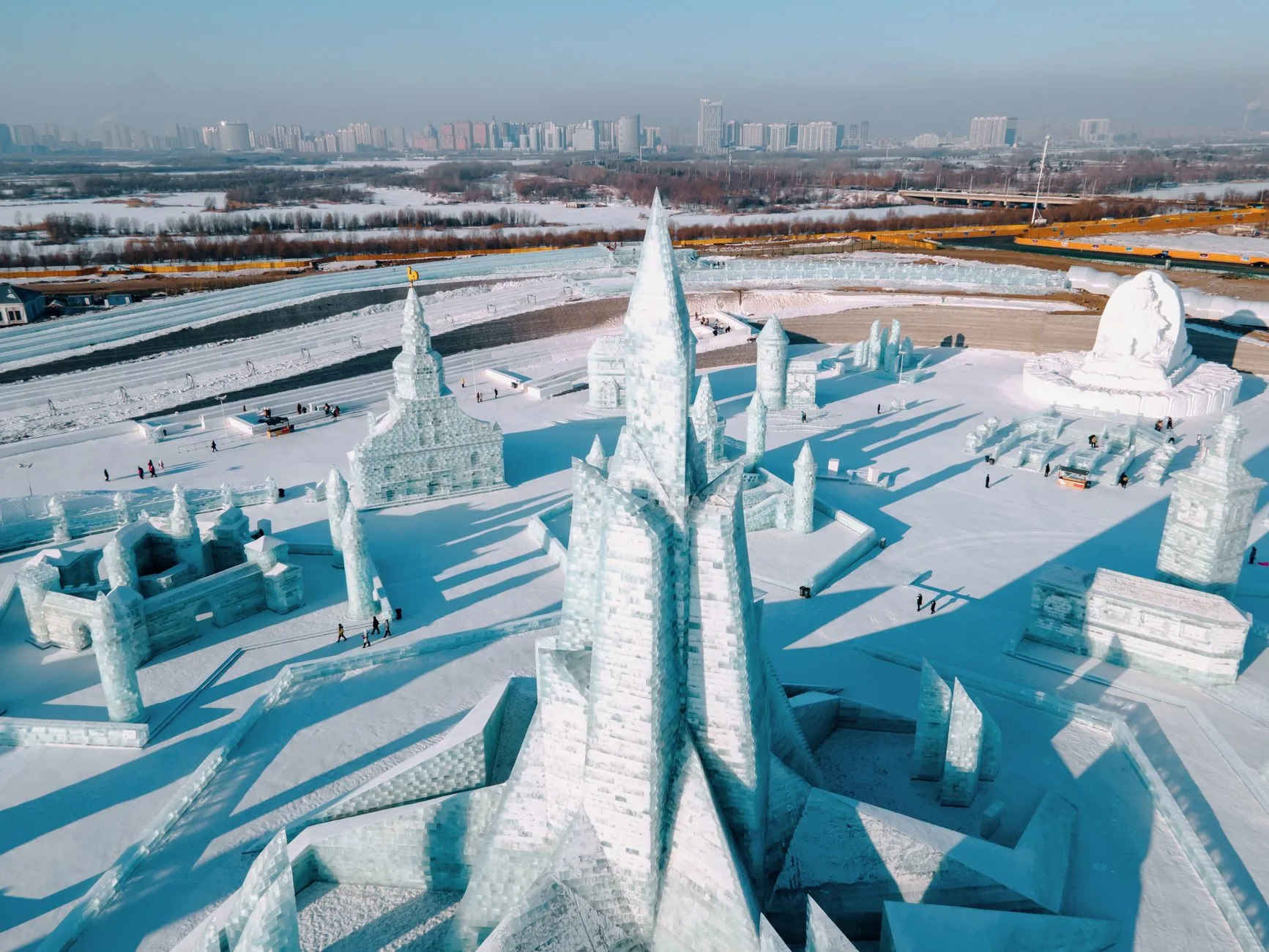 The same ice-carving craft fills Zhaolin Park and the river carnival — both free, both in Daoli.
When to go
| Month | Average high / low | Daylight | What it is like |
|---|---|---|---|
| December | −9.2 °C / −19.0 °C | Shortest days; sunset about 15:50 | Parks open mid-to-late month at partial build. Thinnest crowds of the season; Christmas and New Year pricing. |
| January | −12.0 °C / −22.9 °C | Slowly lengthening | Coldest month and most complete builds. The 5 January festival opening brings crowds. |
| February | −6.3 °C / −18.3 °C | Noticeably longer | Mildest of the three, best value on rooms and tickets — and the month with real melt risk. |
All figures are 1981–2010 climate normals. The official record low for the city is −38.1 °C, set on 4 January 1970.
The weather caveat deserves more than a footnote. Harbin’s ice economy depends on sustained cold, and warm winters shorten it. The 52nd Zhaolin Ice Lantern Show shut on 19 February 2026 because temperatures rose, and the 27th Ice and Snow World also closed early that same season. If your trip falls in late February, buy refundable tickets and keep an alternative.
For the wider picture — Altay, Changbai Mountain, Yabuli and the warm south — see where to go in China in winter.
Where to stay
| Area | Rate level | Best for | Watch out for |
|---|---|---|---|
| Central Street / Daoli | Highest | First visits. Walk to Sophia, Zhaolin, the river and Metro Line 2 | Snow-season pricing bites hardest here |
| Harbin West (哈西) | Mid | Late arrival or early departure on high-speed rail | Little to see nearby |
| Songbei | Mid | Being close to Ice and Snow World | Thin on restaurants and shops; quiet outside snow season |
| Nangang | Mid-low | Eating like a local, station access | Least convenient for the riverfront sights |
Snow-season rates run roughly 30–50% above shoulder season according to the Harbin Tourism Association’s published “integrity pricing” guidance for 2025-26; some media reporting puts the spread as wide as 30–60%. Either way, the practical move is three nights in Daoli rather than the cheapest room in Songbei and an hour a day commuting across the river in the dark.
Most foreign visitors book through international platforms. Our guide to how foreigners book hotels in China covers the passport-and-registration friction involved.
What to see in the city
Central Street (中央大街). A 1,450 m pedestrian avenue paved in 1924 with roughly 870,000 granite blocks, lined with 71 European-style or European-revival buildings — 13 of them municipally protected — spanning Renaissance, Baroque, eclectic and Art Nouveau. It is free and always open, running from Jingwei Street north to the Flood Control Monument and the river. The ritual is buying a Madier popsicle (¥5) from the window at No. 89 and eating it outdoors at −20 °C; Xinhua filmed the queue doing exactly that in January 2026. Since 31 December 2025 the street has a heated assistance station (09:00–22:00, free hot water, ginger tea, phone charging, basic first aid) with outdoor heaters along the core stretch — worth knowing when you have misjudged your coat.
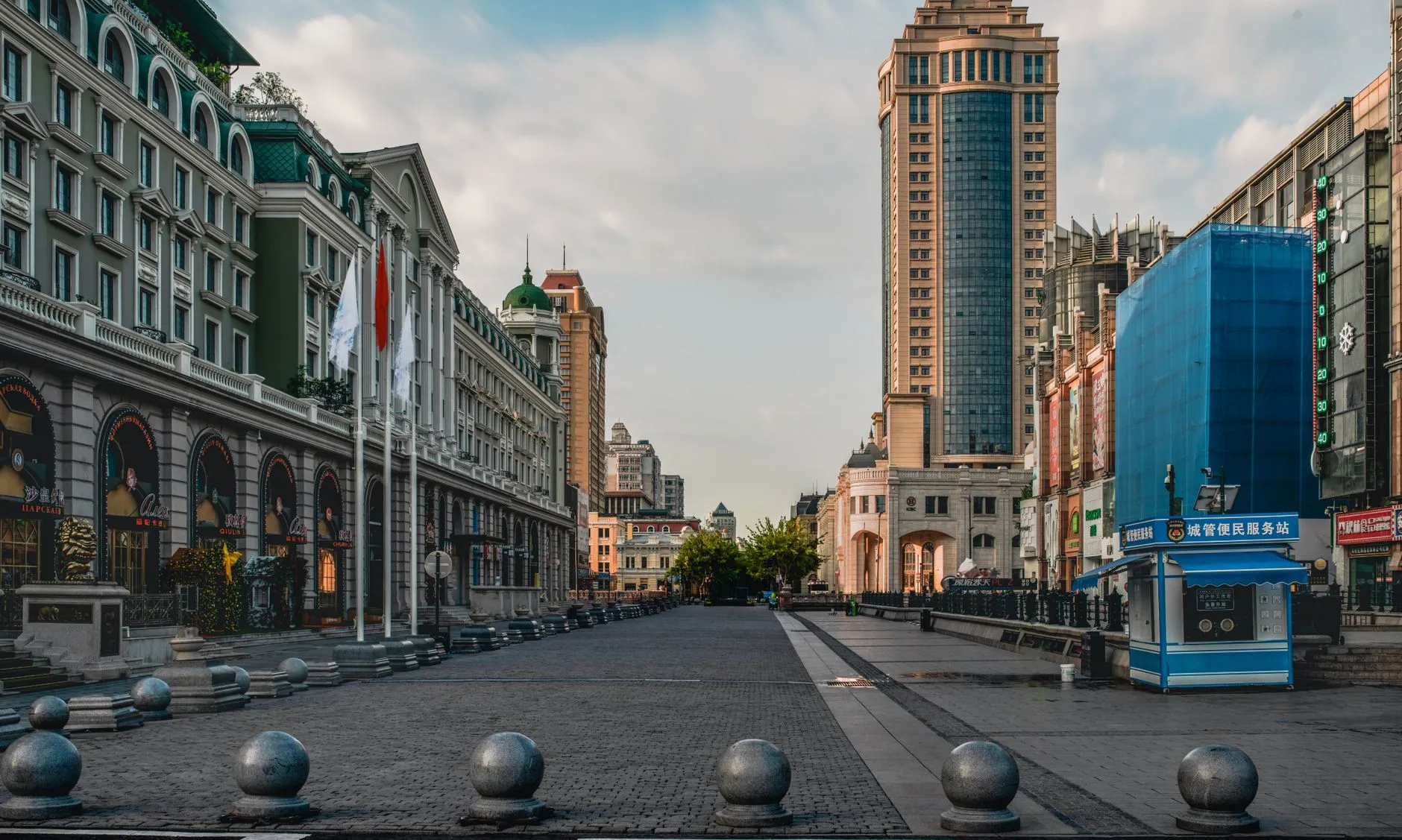 Central Street: 1,450 m of granite blocks, 71 European-style buildings, free and always open.
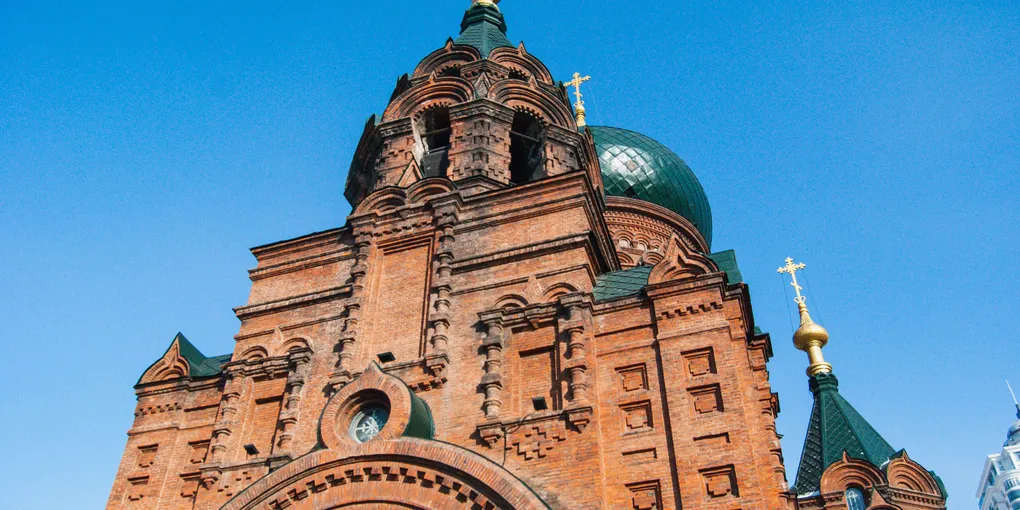
Saint Sophia Cathedral (圣索菲亚教堂). Harbin’s postcard image and its most misunderstood building. The original was a timber military church in 1907; the brick-and-stone body went up between 1923 and 1932. The main dome reaches 53.35 m with a diameter of 27.8 m. It is a national-level protected heritage site and one of China’s 20th-century architectural landmarks — and it is no longer a church. It functions today as the Harbin Architectural Art Gallery. The square is free and always open; the interior asks roughly ¥20–25 per OTA listings (¥15 concession), and no official price is publicly posted, so check at the gate. It is the one Harbin building every visitor photographs and almost nobody enters.
Old Daowai and the Chinese Baroque (中华巴洛克). The largest surviving Chinese Baroque district in the country: European facades wrapped around Chinese courtyard houses, roughly bounded by Jingyang and Jingyu streets, and free to walk. It is where the city eats rather than where it poses. Long-standing names include Lao Renyi (Halal, founded 1912, beef dumplings) and Lao Dingfeng (pastries, 1911) — both recorded by the district government or provincial culture authority, which is more than can be said for most “famous old shop” claims.
Siberian Tiger Park (东北虎林园). In Songbei, holding close to 1,000 purebred Siberian tigers. Official ticketing: ¥70 admission, ¥110 including the tour bus, ¥130 including the “thrill” bus, with half-price at ¥45; visitors over 65 enter free but still pay for the vehicle. Buy the bus. The free-range enclosures can only be traversed in a closed vehicle, so the ¥70 walk-up ticket keeps you on pedestrian boardwalks away from the tigers themselves.
Harbin Grand Theatre. The sweeping shell complex on Songbei’s culture island: 1,432 seats in the opera hall, a 410-seat studio, and public roof walkways you can use for free. Interior visits run about ¥9.9. Closed Mondays.
If you have spare days: Harbin Polarland (indoor white whale performance), Volga Manor (¥188 official, ¥168 booked a day ahead — allow half to a full day), Gogol Street with the 1935 Saint Alexeyev Church, and the Harbin Museum cluster on Liushu Street (free, Tuesday to Sunday 09:00–16:00, closed Mondays).
Ice and Snow World — the short version
You should go. It is the largest ice-and-snow theme park on earth, rebuilt from scratch every single winter out of blocks cut from the Songhua, and there is nothing else remotely like it.
Beyond that, almost everything you need is operational detail that belongs in the dedicated guide: what the ticket costs, what is bundled in, how the timed reservations for the headline slide and the Snowflake Ferris wheel actually work, which Metro exit to take, and when the last train leaves after the night show empties out.
Two things belong here, because they shape how the park fits into your days:
- It is in Songbei, across the river from where you are sleeping. Metro Line 2 solves the journey, but not the timing: the park takes an afternoon-to-evening block, not an hour.
- It is cold for the entire visit, because standing on a river of milled ice after dark is exactly what it sounds like. Do not schedule it after a full day outdoors on Central Street.
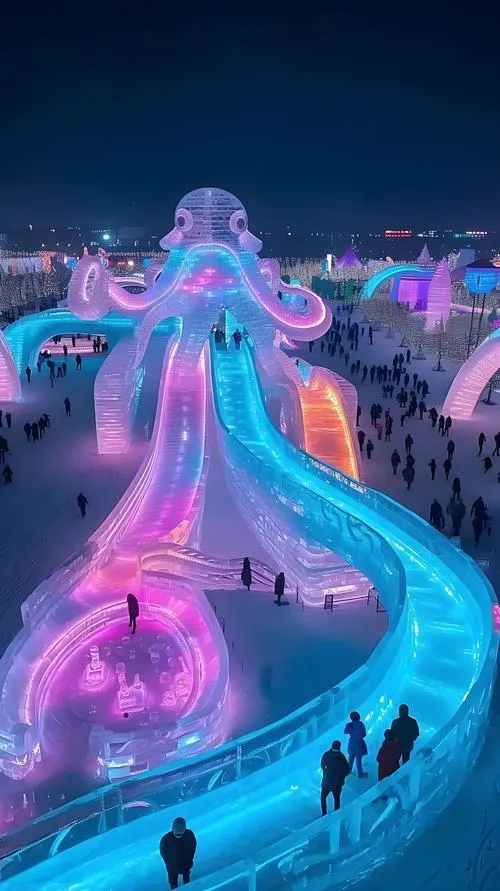 The ice park is carved fresh each winter from Songhua River ice. Prices, reservations and timing live in our dedicated guide.
Beyond the city: Yabuli and Snow Town — check your visa first
Harbin sits at the top of a winter triangle, and both other corners deserve a night.
Yabuli is China’s best-known ski resort, 190–220 km away. High-speed rail reaches it in as little as 1 hour 8 minutes, roughly 30 trains a day, second class about ¥76. Driving takes around three hours.
China Snow Town (雪乡) is Double Peak Tree Farm in Hailing county, Mudanjiang — 260–350 km and 4.5–5 hours overland, or about ¥120 on a direct coach from Central Street. It is famous for the snow that caps every roof into a mushroom, and it is the most photographed village in northeast China.
🔴 The catch, and it is a large one. Both places are outside Harbin’s administrative boundary. If you entered China on the 240-hour transit exemption, your permitted stay area in Heilongjiang is Harbin city only. Snow Town is in Mudanjiang; Yabuli is in Shangzhi. Visiting either on a 240-hour transit is not permitted. This is probably the most common planning error foreign visitors make in Heilongjiang, and English guides almost never mention it. If you want to see them, arrange a regular tourist (L) visa before departure. The mechanics are set out in our 240-hour transit guide.
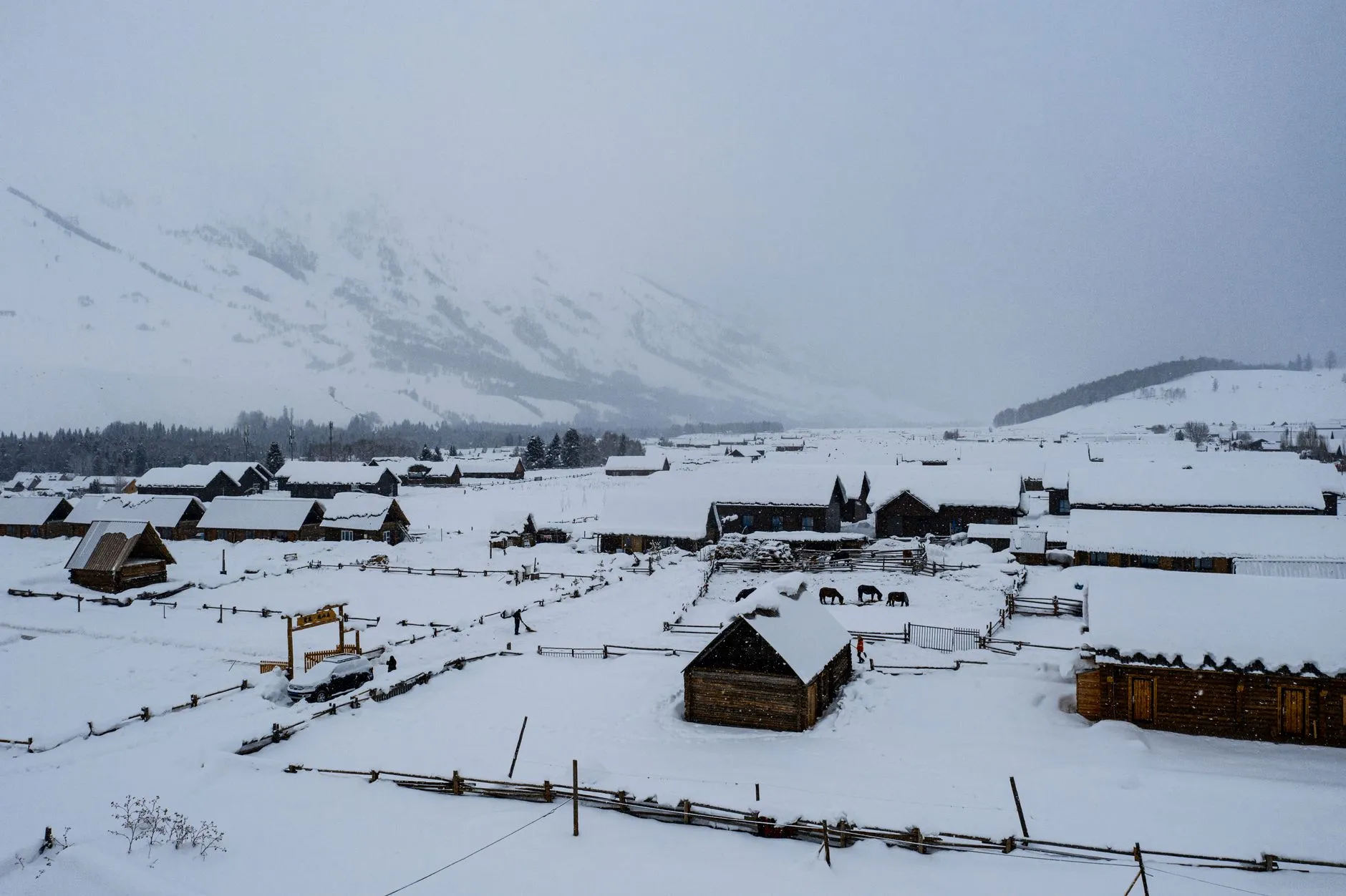 Snow-covered villages in northern China are what the trips out of Harbin are for — and the reason to check your visa before booking one.
Getting there and around
Flying in. Harbin Taiping International (HRB) sits about 33 km south-west of the centre. Terminal 1 handles international and regional flights, Terminal 2 domestic, and the two are connected. For the 2025-26 ice season the airport was serving 12 international and regional routes — Hong Kong, Tokyo, Osaka, Seoul, Singapore and seven Russian cities — and from January 2026 it added Bangkok, Kuala Lumpur, Hanoi and Ho Chi Minh City, reaching 16 international and regional points.
There is no metro to the airport; the planned Line 9 airport link has not been built. Your options are therefore:
| From HRB | Cost | Time |
|---|---|---|
| Airport coach (lines to Central Street, Harbin station, Harbin West, Ice and Snow World) | Flat ¥20 | 40–60 min depending on line and traffic |
| Taxi / ride-hail to Central Street | Roughly ¥80–100 | 40–60 min; metered from ¥8 for 3 km, then about ¥1.90/km (2025 tariff) |
Book a ride-hail through the app rather than accepting a driver in the arrivals hall — see our DiDi guide.
Four stations, one city. Harbin has four railway stations, and mixing them up costs hours:
| Station | Role | Metro |
|---|---|---|
| Harbin West (哈尔滨西) | The main high-speed station — Beijing, Dalian, most G-trains | Line 3 |
| Harbin (哈尔滨) | Conventional services plus some intercity; closest to Central Street | Line 2 |
| Harbin East (哈尔滨东) | Short-distance conventional trains | Line 1 |
| Harbin North (哈尔滨北) | Mostly intercity, over in Songbei | Line 2 |
Note especially that Harbin North is not Harbin station. They are far apart and on different lines, and this is a routine ticketing mistake.
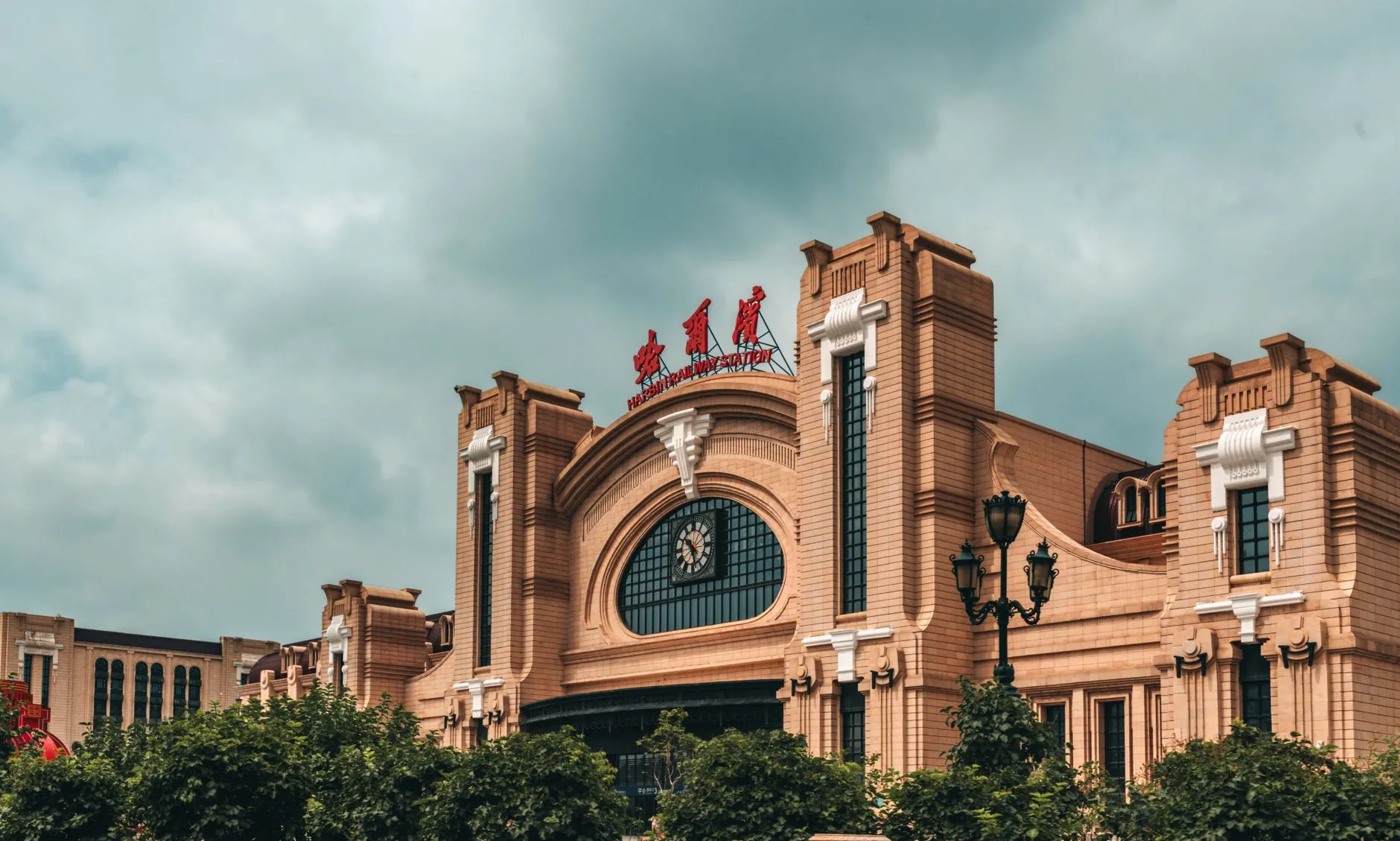 Harbin station, not Harbin North. The city has four, and putting the wrong one on a ticket costs hours.
Beijing to Harbin takes about 4 hours 30 minutes at best, second class roughly ¥550–650. Travelling over New Year or Spring Festival? Buy the moment your booking window opens — see how to buy Chinese train tickets.
Within the city. Three metro lines run roughly 06:00–22:30, fares ¥2–7. Line 2 is the tourist line: Central Street, Shangzhi Street (the nearest stop to Saint Sophia), Ice and Snow World, Harbin station and Harbin North. If you learn one route, learn this one. Harbin has no operating heritage tram — the original trams ran 1927–1987, and the 2003–2008 Gogol Street revival line has also stopped.
Taxis start at ¥8 for 3 km. That is the easy part. The harder truth, reported consistently by local media, is that winter journeys on ice can take 50% longer than usual, and empty cabs get scarce after snowfall and at rush hour. Budget for it and prefer the metro. One caveat on intercity rail: the high-altitude-cold lines here slow to about 160 km/h when winds exceed 20 m/s or snow depth passes 50 mm, and severe blizzards can suspend service outright.
What to eat
Harbin red sausage (红肠 hóngcháng). The smoked sausage that defines the city’s food identity and its souvenir trade. Three names matter: Qiulin Lidaosi (founded 1900, the Russian-style original, widely stocked and available vacuum-packed), Harou Lian (1913 state-era brand, more garlic, in every supermarket), and Shangwei, which has no branches at all — a single shop on Hongqi Street in Daowai that locals queue at for the freshest batch.
🔴 You cannot take it home. Sausage is a meat product. Chinese customs rules prohibit carrying or mailing meat products (General Administration of Customs Announcement No. 470), and most destination countries prohibit importing them anyway. Buy it to eat while you are in China. This catches a lot of people at the airport, after they have spent ¥200 on gifts.
Madier popsicles. ¥5, bought at a window on Central Street, eaten outdoors in sub-zero air. It is not a tourist stunt; it is what people here actually do.
Guoborou (锅包肉). Crisp-fried pork in a sweet-sour glaze, and the subject of a permanent argument. The Heilongjiang school uses vinegar and sugar, no ketchup, and comes out golden. The Liaoning school uses tomato sauce and comes out red. Harbin considers itself the origin and looks down on the Liaoning version; Laochujia is the restaurant most associated with the origin story, which it traces to a late-Qing official’s household around 1907.
Russian food. Harbin has served Western food continuously since the railway arrived in 1898 and styles itself China’s capital of Western cuisine. Historic survivors include Huamei Xi Canting (1925, 112 Central Street) and Lucia (1924, just off Xitoudao Street), alongside Tatos (1901) and Madier’s own dining room (1906). Expect old rooms and a time-capsule atmosphere rather than modern fine dining.
Practicalities. Most restaurants have no English menu, and ordering frequently happens by scanning a QR code into a Chinese-language mini-program, which is awkward on a foreign phone. Carry a card with allergies and refusals written in Chinese, assume nothing about being understood in English, and keep cash handy because some small places are effectively mobile-payment-only. Our Chinese food guide for foreigners goes further on ordering strategy.
The foreign-visitor checklist
Visas first, because the whole trip depends on them — and because the two relevant policies are constantly confused with each other.
| Unilateral visa exemption | 240-hour transit exemption | |
|---|---|---|
| What it is | Visa-free entry for ordinary passport holders of about 50 countries, up to 30 days, for tourism, business, family visits or transit | Transit to a third country, up to 240 hours (10 days) |
| Where it works | All open ports, whole country, no stay-area limit | 57 countries, 65 ports — Harbin Taiping is one of them — but the Heilongjiang stay area is Harbin city only |
| Expiry | Most countries: 2026-12-31. Russia until 2027-12-31; Brunei indefinite | No announced end date |
That third row is the one to stare at. If you arrive in January or February 2027, unilateral visa-free entry has already expired for most nationalities, including the US, UK, Canada, Australia, Japan, Korea and most of the EU. Do not assume you can walk in because you could in 2026. Check the current visa-free country list before booking anything non-refundable, and read the Harbin-specific analysis in our Ice and Snow World visa section.
The rest of the checklist:
- Register your address within 24 hours. This is a legal duty, not a hotel formality. Hotels do it automatically; if you stay in an apartment, a homestay or a friend’s home, you or your host must register with the local public security authority within 24 hours of arrival. Non-compliance draws a warning and can carry a fine of up to ¥2,000. Since September 2026 registration can also be completed online through the National Immigration Administration’s 12367 platform, which removes the old excuse that it was too inconvenient.
- Sort payments before you land. Bind a foreign card to Alipay and WeChat Pay before departure — the walkthroughs are here and here — and keep some cash as a fallback. More detail in how to pay in China. Shopping seriously? Check the tax refund rules.
- Sort the internet before you land. Install a travel eSIM before departure: a Chinese SIM sits behind the firewall, while roaming or a travel eSIM generally does not. Compare options in our eSIM vs SIM guide and getting online in China.
- Know the numbers. 110 police, 120 ambulance, 119 fire. 12345 is Harbin’s round-the-clock public service hotline, which staffed English, Japanese and Korean interpreters through the 2025 Asian Winter Games. 12308 is the Ministry of Foreign Affairs’ consular protection line (+86-10-12308 from abroad).
- Medical, if it comes to that. The Second Affiliated Hospital of Harbin Medical University runs an international medical centre with English throughout and experience handling foreign insurance. Most other facilities will not offer English.
Winter hazards nobody warns you about
Do not walk on the Songhua. It freezes into what looks like a solid plaza, and the temptation is enormous — it is the straightest line across the city. It is prohibited. Harbin Public Security Bureau issues the order annually; the current version, dated 24 November 2025, states that from publication, all vehicles and pedestrians are forbidden from crossing the ice surface on the Songhua River within Harbin. Ice thickness varies, open channels run beneath it, and people die. The organised river carnival is built and supervised; the rest of the river is not yours.
Your phone will quit. Apple lists 0–35 °C as the operating ambient temperature for iPhone and −20–45 °C for storage; below the operating range it may shorten battery life, shut down, or refuse to charge. Keep it in an inner pocket and put a hand warmer against it. The same cold empties camera batteries, so carry spares warm.
Hand warmers are fine to fly with. The ordinary iron-powder-and-charcoal type contains no lithium cell, so it is allowed in both cabin and checked bags, in any quantity. The rechargeable kind — electric hand warmers, heated insoles — is a power bank in the airline’s eyes: carry-on only, ≤100Wh, and needing a Chinese CCC mark for domestic flights. Those are the same rules that apply to every domestic sector in China — see Domestic Flights in China: A Foreigner’s Guide.
Recognise frostbite and hypothermia. Hypothermia means core temperature below 35 °C: mild 32–35 °C, moderate 28–32 °C, severe below 28 °C. Frostbite runs from numbness and pallor, through blisters, to full-thickness tissue damage. Treatment is to get out of the cold and rewarm in 37–40 °C water for 20–30 minutes. No fire, no rubbing with snow, and severe cases go straight to hospital.
Walk like a penguin. Short steps, feet slightly turned out. Grip matters more than warmth in footwear: deep-tread winter boots and clip-on cleats. Steps, ramps and the transitions between cleared and uncleared pavement are where people go down.
Refuse suspiciously cheap tours. Heilongjiang prosecutes these, and the case list is public: five agencies and guides penalised in December 2024; an individual fined ¥70,000 in November 2025 for running unlicensed Snow Town tours; a black guide jailed for coercion on the Harbin–Yabuli–Snow Town circuit. Anything dramatically cheaper than the published guidance is cheap for a reason — see our China travel safety guide.
Leave slack. At −25 °C you are not doing a ten-hour day. Build indoor buffers — cafés, shopping centres, a bathhouse — and do not schedule a flight or train immediately after a heavy outdoor morning.
What the English guides get wrong
- “The Ice Festival” and “Ice and Snow World” treated as one thing. One is a citywide festival and the other a ticketed park, and they count their editions separately.
- Nobody mentions that two of the five ice events are free. Zhaolin’s ice lanterns and the river carnival cost nothing and sit within walking distance of Central Street.
- The frozen Songhua presented as walkable. Annual police order says otherwise.
- “Visit Snow Town on your 240-hour transit.” Your stay area ends at Harbin’s city boundary.
- The visa-free assumption. Much English advice was written while unilateral visa-free entry was new. It expires 31 December 2026 for most countries — covering exactly the January–February 2027 trips people are planning now.
- “Take the metro from the airport.” There isn’t one. ¥20 coach or a taxi.
- Red sausage as a souvenir. Customs rules make it pointless to mail home and risky to carry.
- Nobody mentions the 4 p.m. sunset. December daylight runs about 8 hours 40 minutes; every plan has to fit inside it.
- Saint Sophia described as a church. It is the Harbin Architectural Art Gallery.
- Sun Island and the Snow Expo conflated. Same island, separate ticket.
- “The hotel handles registration.” Only if you stay at a hotel. An apartment or a friend’s home makes it yours, on a 24-hour clock.
If you only remember three things
Stay in Daoli. Central Street, Saint Sophia, Zhaolin’s free ice lanterns and Metro Line 2 are all within walking distance — which in winter matters more than saving ¥150 a night somewhere you have to commute from in the dark.
Check your visa against 2027, not 2026. Unilateral visa-free entry expires on 31 December 2026 for most countries, and the 240-hour transit you might fall back on does not let you leave Harbin city limits.
Do not walk on the river. It is illegal, it is enforced by annual police order, and it kills people.
How this was verified
Last verified 2026-09-23. Principal Chinese-language sources:
- Harbin Municipal People’s Government (harbin.gov.cn) — city profile and population (9.887 million registered residents at end-2025); the 38th Snow Expo opening notice; the public security order prohibiting traffic on the Songhua ice.
- Harbin Public Security Bureau — the notice of 24 November 2025 forbidding all vehicles and pedestrians from the river ice, issued annually.
- Ministry of Culture and Tourism (mct.gov.cn) — festival filing records confirming that the 42nd China·Harbin International Ice and Snow Festival opened 5 January 2026, and that Harbin hosts China’s first international ice-and-snow festival, begun 1985.
- Harbin Ice and Snow World Co., Ltd. — the park’s role, schedule framework and edition numbering; pricing and reservation detail belongs to our Ice and Snow World guide.
- Heilongjiang Provincial People’s Government and Department of Culture and Tourism — high-speed rail timings to Yabuli and Mao’ershan, and confirmation of Harbin Taiping as Heilongjiang’s only 240-hour transit port.
- National Immigration Administration (nia.gov.cn) — the 240-hour transit framework currently covering 57 countries and 65 ports, together with the published stay-area table limiting Heilongjiang to Harbin city. Also referenced for the 12367 online accommodation registration route introduced in September 2026.
- Chinese embassies abroad — the FAQ giving unilateral visa exemption validity to 31 December 2026 for most covered countries (Russia to 2027-12-31, Brunei indefinite).
- Harbin Customs (harbin.customs.gov.cn) — meat product prohibitions under GAC Announcement No. 470.
- People’s Daily Online Heilongjiang, Harbin Daily, Xinhua — the taxi tariff change effective 1 January 2025, the Central Street warming station, winter transport conditions, and international route expansion.
- Harbin Tourism Association — published snow-season integrity pricing guidance (30–50% above shoulder season).
- Ticketing platforms (Ctrip, Tongcheng) — used only where no official price is posted, and marked (OTA) in the text; never treated as authoritative.
Every date, price and rule in this guide traces to one of the above. Anything we could not source officially — the 2026-27 festival editions, their prices, and whether Zhaolin stays free — is flagged as unannounced rather than filled in with a plausible number. Read our full methodology.